
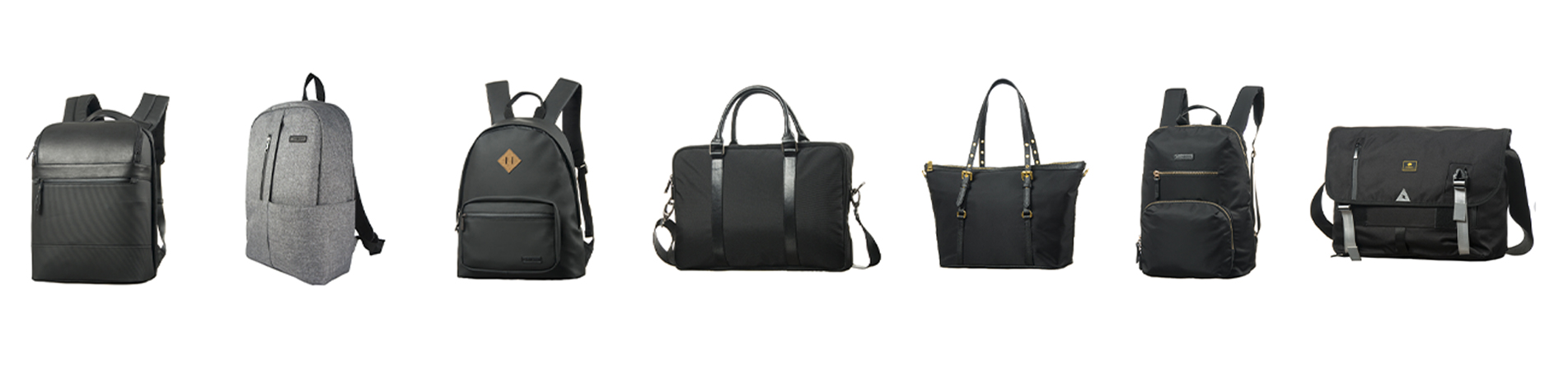
There are two widely used methods for measuring backpack capacity: geometric volume estimation and the ASTM F2153 fill test. During the design stage, the geometric formula (internal length × width × depth ÷ 1,000, multiplied by a pattern correction factor when necessary) can be used to estimate the maximum capacity. For sample approval and production capacity labeling, the unexpanded capacity measured using the ASTM F2153 fill test is generally used as the baseline.
Geometric estimation is best suited to structured bags with regular shapes for preliminary space planning. Applying this method directly to sewn backpacks usually overestimates capacity. The fill test uses rigid plastic spheres with a diameter of 20 mm to fill all enclosed compartments; the spheres are then transferred to a calibrated measuring container to determine volume. The result can be used in purchase contracts, technical packs, inspection criteria, and product capacity labeling. For custom bag manufacturing, specifying the measurement method, included compartments, and tolerance alongside the capacity value helps align acceptance criteria between buyers and suppliers.
Table of Contents
Ⅰ. Why Backpacks with the Same Labeled Capacity Can Have Different Actual Volumes
Ⅱ. Geometric Formula Estimation
Ⅲ. ASTM F2153 Fill Test
Ⅳ. Practical Recommendations for Backpack OEM Projects
Ⅴ. Frequently Asked Questions (FAQ)
Ⅵ. Conclusion
Unlike shoe sizing or fabric weight, backpack capacity is not subject to a globally uniform mandatory labeling rule. Products labeled as 30 L may be measured using four common methods in the industry, producing different usable-volume results.
|
Measurement method |
What is measured |
Typical result |
Notes |
|
Multiply external dimensions |
External length × width × height of the bag |
Likely to be overstated |
Counts fabric, foam, and back-panel structures as volume; unsuitable for labeled capacity. |
|
Main compartment only |
Largest enclosed main-compartment space |
Conservative |
Perceived usable space may exceed the labeled value, but the scope is limited and comparisons are less meaningful. |
|
Add all enclosed pockets |
Main compartment, zippered pockets, and covered enclosed pockets |
More comparable |
Closer to the logic of ASTM F2153; agree in advance whether open pockets are included. |
|
Promote expanded capacity |
Capacity with the roll-top or expansion zipper fully opened |
Represents maximum expanded state only |
Volume is lower in the normally closed state; some expanded bags may exceed airline carry-on limits. |
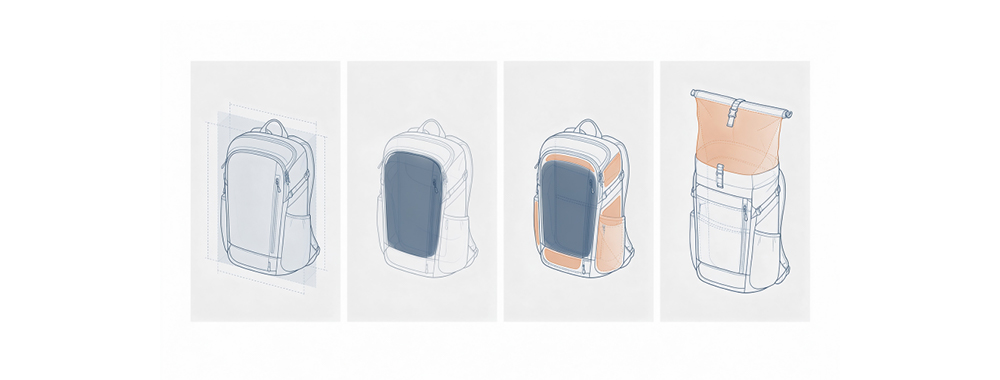
For a daypack labeled 30 L, an external-dimension calculation includes space occupied by the back panel and shoulder-strap structure. Under the ASTM F2153 fill test, only enclosed compartments are counted; mesh water-bottle pockets and open front stash pockets are excluded. As a result, the unexpanded measured capacity may be only 24–25 L.
Such differences are usually not manufacturing defects. They primarily result from different measurement methods and boundaries for what is included.
Capacity can be reported as unexpanded capacity and expanded capacity. Unexpanded capacity refers to the bag in its normally closed, everyday-use configuration. Expanded capacity is the maximum volume available when a roll-top is fully opened or an expansion zipper is completely unzipped.
A specification sheet that lists only one capacity value does not clearly identify the intended use state and makes inspection decisions more difficult. For roll-top bags and bags with expansion zippers, also verify the fully loaded external dimensions to determine whether the bag meets carry-on baggage size limits.
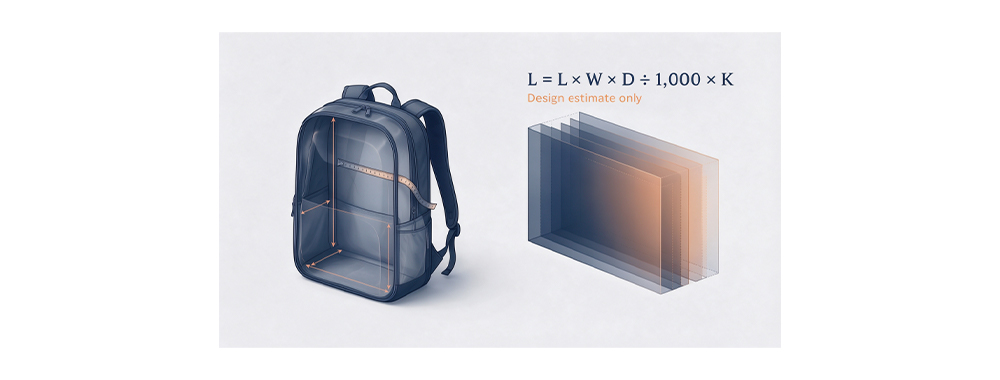
A general geometric formula used in backpack OEM development is:
Capacity (L) = Internal Length (cm) × Internal Width (cm) × Internal Depth (cm) ÷ 1,000
Example: With internal dimensions of 50 × 30 × 20 cm, the theoretical capacity is 50 × 30 × 20 ÷ 1,000 = 30 L.
The formula uses centimeters and returns liters, based on 1 L = 1,000 cm³. For the North American market, capacity may also be listed in cubic inches; 1 L ≈ 61.024 cu in.
• Reverse-engineering target dimensions during concept design: allocate internal usable dimensions based on the target capacity to support pattern and construction development.
• Quickly estimating a capacity range during initial inquiries: when no physical sample is available, use external dimensions to make a preliminary assessment of the product category and support quotation and process evaluation.
• Planning internal space before sampling: allocate space among the main compartment, laptop compartment, and front pockets, using the result as a theoretical upper-limit reference.
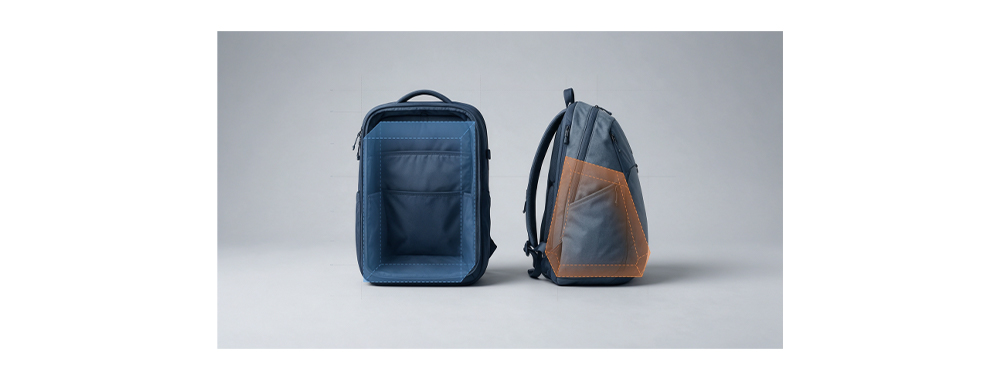
• The bag is not a perfect rectangular prism: daypacks that taper toward the top, roll-top bags, flap-top bags, and packs with curved suspension profiles have irregular shapes that cannot be accurately represented by a rectangular prism.
• Fabric, foam, and suspension components reduce usable volume: laptop sleeves, back panels, and shoulder-strap anchor structures occupy space within the bag’s external profile.
• Pocket-counting rules vary: external-dimension calculations may include side and front pockets, whereas standard fill testing counts enclosed compartments only and excludes open mesh pockets.
• Seam allowances and lining thickness reduce usable space: sewing allowances, lining, and reinforcement materials reduce the effective internal volume.
Conclusion: The geometric formula is a design-screening tool for estimating theoretical maximum volume; it should not be used directly as the labeled capacity of a sewn backpack. Results are more accurate for rectangular tote bags and simple travel duffels. For backpacks, technical outdoor packs, and styles with multiple complex compartments, capacity acceptance should be based on a fill test.
During early development, before a physical sample is available, a pattern correction factor can help narrow the gap between theoretical and measured capacity. The adjusted formula is:
Estimated capacity (L) ≈ [Internal length × internal width × internal depth (cm) ÷ 1,000] × K
Select K according to the regularity of the bag’s shape. The ranges below are based on pattern databases and industry experience and are for design estimates only—not for official capacity labeling. The estimate must ultimately be calibrated against an ASTM fill test.
|
Bag construction |
Reference correction factor |
Notes |
|
Boxy business backpack |
0.80–0.85 |
Regular shape with high space efficiency. |
|
Standard daypack |
0.75–0.80 |
Slightly contoured shape and space occupied by compartments. |
|
Outdoor hiking pack (internal aluminum-frame back panel) |
0.70–0.75 |
Suspension system takes up more internal volume. |
|
Cylindrical duffel |
0.72–0.78 |
Curved side walls reduce usable volume. |
|
Roll-top backpack |
0.65–0.75 |
The rolled closure section is excluded from effective capacity. |
|
Tapered daypack, narrower at the top |
0.70–0.78 |
The tapered cross-section makes the upper space less efficient. |
Example: A standard daypack with internal dimensions of 45 × 30 × 18 cm has a theoretical volume of 24.3 L. Using a correction factor of 0.78 gives an estimated capacity of approximately 19 L; subsequent fill testing will generally yield around 18–20 L.
Important limitation: Correction factors are not universally transferable across factories or patterns. If the fabric weight or lining construction changes, re-test the bag and recalibrate K. In external technical communications, label this figure as a “design estimate,” not the contractual labeled capacity.
A commonly used industry standard for backpack capacity testing is ASTM F2153, “Standard Test Method for Measurement of Backpack Capacity.” It is a voluntary test method intended to establish consistent, comparable capacity-measurement rules among brands, factories, and inspection teams.
Key principles: report both unexpanded and expanded capacity; count enclosed compartments only; exclude open mesh water-bottle pockets, open front stash pockets, and open compression pockets. The standard generally does not apply to small bags under 4 L. Crossbody mini bags, waist packs, and small organizers do not need to be labeled in liters; if a capacity value is provided, identify the alternative simplified test method used.
|
Step |
Procedure |
Control point |
|
1. Prepare the test media |
Use uniform rigid plastic spheres with a diameter of 20 mm, commonly PP or PS. |
Foam beads and beans are for rough internal checks only; they compress or settle and have poor repeatability. Do not use them for official capacity labeling. |
|
2. Fill all enclosed compartments |
Fill the main compartment and every zippered pocket. For roll-top bags, fill to the agreed number of rolls while ensuring normal closure. Close zippers after filling without pulling them taut. |
Do not omit any enclosed compartment. Exclude all open pockets. |
|
3. Use a consistent settling procedure |
Gently shake the bag so the spheres settle naturally. A common procedure is three gentle shakes, approximately 10 seconds each. |
Do not deliberately press or compress the bag to inflate the reading. |
|
4. Transfer the spheres to a calibrated measuring container |
Transfer all spheres into a graduated container calibrated by water-volume measurement. Gently agitate until the spheres settle, then record the volume. Large backpacks may be measured in multiple batches and the readings added together. |
Calibrate measuring equipment with water periodically and retain calibration records. |
|
5. Repeat the test and average the results |
Conduct at least two independent tests. If the results differ by more than 1–2 L, filling or settling procedures may not have been consistent; repeat the test. |
Use the same spheres and measuring equipment for first-piece, in-line, and final inspections. |
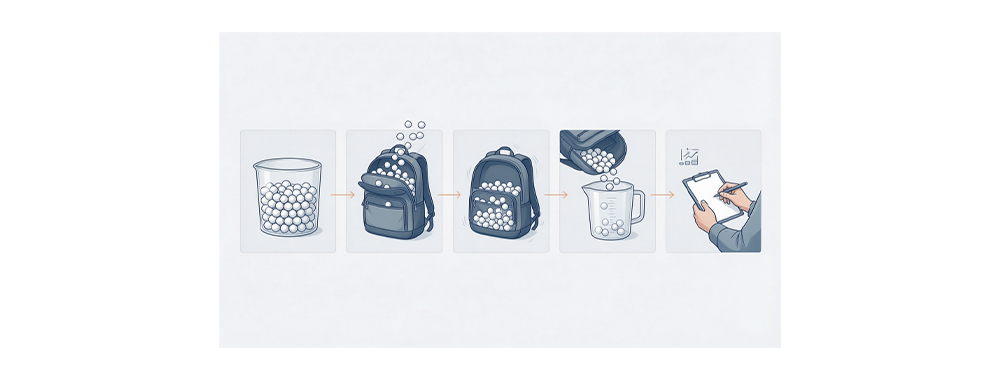
ASTM F2153 is voluntary and is not legally mandatory. Many retail product listings also omit the test method. The value of the test is that it allows the fill media, measuring equipment, included compartments, and tolerances to be defined in the specification sheet. If only a capacity number is listed without test details, results from different stages cannot be reliably compared.
Not every inspection site has enough standard plastic spheres and calibrated measuring containers. A simplified method may be used during sampling, but the specification sheet must state that it differs from ASTM F2153.
|
Scenario |
Simplified method |
Notes |
|
Compartments of 4 L or more |
Fill with 20 mm plastic spheres or uniform dry beans, then measure using a 1 L measuring cup and add the readings. |
Beans are for internal reference only; rigid plastic spheres are preferred for official capacity labeling. |
|
Compartments under 4 L |
Because small spheres stack with greater error, weigh the filling material first and convert to volume using a defined ratio if necessary. |
State in the documentation: “Not the ASTM F2153 standard procedure.” |
|
Curved or tapered bags |
Fill in vertical sections and add the readings from each section. |
A single rectangular-prism calculation will overestimate the capacity of tapered bags. |
|
Backpacks with multiple compartments |
Fill and measure each enclosed compartment separately, then total the results; list open pockets separately as excluded. |
Keep separate records to avoid confusion over what is included. |
Important: Capacity values obtained using different measurement methods should not be compared directly.
To reduce the risk of a finished product’s capacity differing from expectations, include the following six items in the capacity section of the specification sheet:
|
Field |
Recommended wording |
Purpose |
|
Measurement method |
“ASTM F2153 fill test using 20 mm PP spheres” / “Calculated from external dimensions; design reference only.” |
Identifies the method used to determine capacity. |
|
Unexpanded capacity |
Capacity in liters in the normally closed state. |
Matches typical use and product labeling. |
|
Expanded capacity |
Capacity in liters with the expansion zipper fully open or the roll-top fully unrolled. |
Distinguishes maximum expanded volume. |
|
Compartments included |
“Includes the main compartment and all zippered pockets; excludes mesh water-bottle pockets and open front stash pockets.” |
Removes ambiguity about which pockets count. |
|
Units |
List L and cu in together and specify the conversion. |
Supports reading preferences in different Western markets. |
|
Tolerance |
Agree on a tolerance by capacity range; use the same test method when judging compliance. |
Sets a reasonable acceptance range for inspection. |
Capacity: 28 L unexpanded (approx. 1,709 cu in) / 34 L expanded (approx. 2,075 cu in), measured using the ASTM F2153 fill test with 20 mm PP plastic spheres. Includes the main compartment and all zippered pockets; excludes mesh water-bottle pockets and open front stash pockets. Tolerance: ±1.5 L. File the test record with the initial sample approval documents.
|
Capacity range |
Suggested tolerance |
Application notes |
|
Under 20 L |
±1 L |
Small bags are sensitive to compartment and opening design; test conditions must be controlled. |
|
20–40 L |
±1.5–2 L |
Common range for daypacks and commuter laptop backpacks. |
|
Over 40 L / large travel bags |
±2–3 L |
Fill-test variation may be greater for large bags; additional repeats are recommended. |
|
Retail products with strict controls |
±3%, or agree that “labeled capacity must not exceed measured unexpanded capacity.” |
Suitable for tightly controlled cross-border retail programs. |
Note: Tolerance criteria must correspond to the capacity test method. A tolerance established using external dimensions cannot be used to judge results from a fill test.
|
Type of discrepancy |
Explanation |
Control measure |
|
Including open pockets in labeled capacity |
The counting method differs from ASTM and can produce inconsistent figures. |
Clearly list included and excluded pockets in the specification sheet. |
|
Advertising only expanded capacity |
Does not reflect volume in the product’s normally closed state. |
Provide both unexpanded and expanded capacity. |
|
Using external dimensions directly for sewn backpacks |
Foam, back panels, and lining take up space, so the calculated value is high. |
Use fill testing as the basis for labeled capacity; use external dimensions only as a supplementary reference. |
|
Using one capacity value for all sizes of a style |
Pattern and suspension structures change by size, affecting volume. |
Test each size independently. |
|
Testing only the first sample, with no production recheck |
Pattern adjustments, lining changes, and pocket revisions can change capacity. |
Test the approved reference sample and production trial units. |
|
Mixing metric and imperial units without labels |
Can lead to misinterpretation of readings. |
List both L and cu in in technical documents, with the primary unit suited to the target market. |
Two products labeled with the same capacity may not perform equally in actual loading. Compare external dimensions, the main compartment’s internal usable dimensions, opening design, and photos of the bag when loaded. Even when both are labeled 30 L, a boxy pack and a tapered pack may accommodate different shapes of items.
For travel backpacks and school backpacks, capacity is only one consideration. Flap-top designs are better suited to flat items, while top-loading roll-top bags offer good compression but can make items deep inside the bag harder to access. For a more complete assessment, include capacity, main-compartment internal dimensions, opening type, and fully loaded external dimensions in the specification sheet.
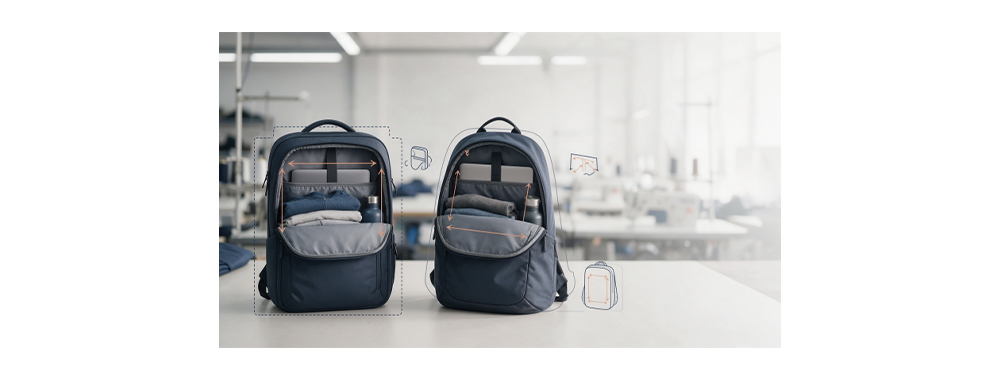
Lock in the capacity baseline during initial sample approval. Once the first sample is complete, test capacity using the agreed method. After the parameters are approved, record them in the technical pack and purchasing documents before starting mass production.
During inspection, use the same sphere specifications, measuring equipment, and settling procedure as for the approved sample, and assess the results against the agreed tolerance.
Capacity testing is a technical specification activity and is separate from chemical testing of materials. Nevertheless, related records should be archived together for easy reference.
If a product is labeled as using recycled fabric, the material claims should align with applicable GRS, GOTS, or OEKO-TEX documentation. Children’s backpacks sold in the United States must also meet applicable CPSIA requirements. A substantial discrepancy between labeled and measured capacity may create a risk of misleading advertising in the US and European markets. Store capacity test records and compliance certificates in the technical pack so they can be retrieved for customer factory audits and marketplace reviews.
This formula estimates only the theoretical upper limit. It counts fabric, foam, and back-panel structures as volume and therefore generally overestimates usable space in sewn backpacks. The discrepancy is smaller for rectangular tote bags and simple travel duffels. For backpacks, outdoor packs, and styles with multiple compartments, capacity acceptance should be based on the ASTM F2153 fill test. A pattern correction factor can support early sampling estimates, but the result is for internal reference only and must not be used as the official labeled capacity.
ASTM F2153 is a voluntary test method for measuring backpack capacity; it is not legally mandatory. The core procedure is to fill all enclosed compartments with 20 mm rigid plastic spheres, transfer the spheres to a calibrated measuring container, and record both unexpanded and expanded capacity. Open water-bottle pockets and open stash pockets are excluded. The buyer and supplier should agree on whether to use the method in the technical documentation; once agreed, it becomes the basis for acceptance.
This is usually due to differences in measurement methods—for example, using external dimensions or including open pockets in the calculation. A difference of around 20% between a daypack’s labeled capacity and its ASTM fill-test result is not unusual in the industry. Buyers and suppliers can establish a consistent basis for acceptance by agreeing in advance on the test method, pocket-inclusion rules, and tolerance range in the specification sheet.
For bags under 20 L, a tolerance of ±1 L is suggested; for 20–40 L, ±1.5–2 L; and for large bags over 40 L, ±2–3 L. For tightly controlled retail programs, the tolerance can be narrowed to ±3%, or the parties can agree that “the labeled capacity must not exceed the measured unexpanded capacity.” Use cubic inches (cu in) alongside liters for North America, while liters are generally preferred in Europe. Conversion: 1 L ≈ 61.024 cu in.
ASTM F2153 generally does not apply to bags under 4 L. A simplified method can use a calibrated measuring cup, uniform dry beans, or a weight-to-volume conversion. The specification sheet must state that the method is “not the ASTM F2153 standard procedure.” Small spheres can stack inconsistently in small compartments, so external capacity claims for small bags should be made cautiously.
They may be used for rough internal checks, but capacity figures used in contracts, specification sheets, or product labeling should not be based on rice or beans. Grains settle under pressure, and results vary between operators and batches, making repeatability poor. For formal testing, use 20 mm rigid PP/PS spheres and calibrated measuring equipment.
ASTM F2153 does not mandate a specific number of roll-top folds, which can lead to disagreement for this style. The buyer and supplier should agree in writing in the technical pack on the number of folds used for normal closure (commonly 2–3 rolls in the industry). Fill the bag to the agreed number of rolls and confirm that it closes normally without fabric tension; record this as the unexpanded capacity. The reading with the roll-top fully unrolled is the expanded capacity.
From using geometric estimates to support early pattern planning, to determining labeled capacity through ASTM F2153 fill testing, and then specifying the test method, included compartments, and tolerances in clear technical terms, a verifiable capacity-assessment system is central to bag capacity management. Consistent criteria help project stakeholders avoid misunderstandings about specifications. As a professional bag manufacturer, we can support capacity-related technical requirements and help align project specifications with the agreed standards. Please contact us if you need assistance.
| Author | ||||||
|
Continua a leggere, resta aggiornato, iscriviti e ti diamo il benvenuto per dirci cosa ne pensi.




Diritto d'autore
@2024 Synberry Bag & Package Products Co.,Ltd Tutti i diritti riservati
.
 RETE SUPPORTATA