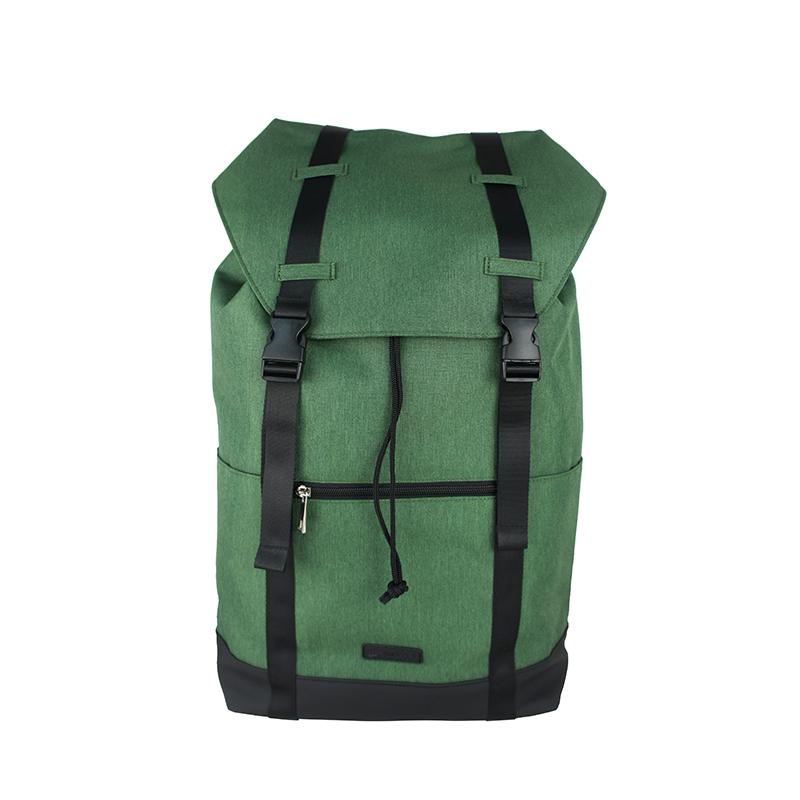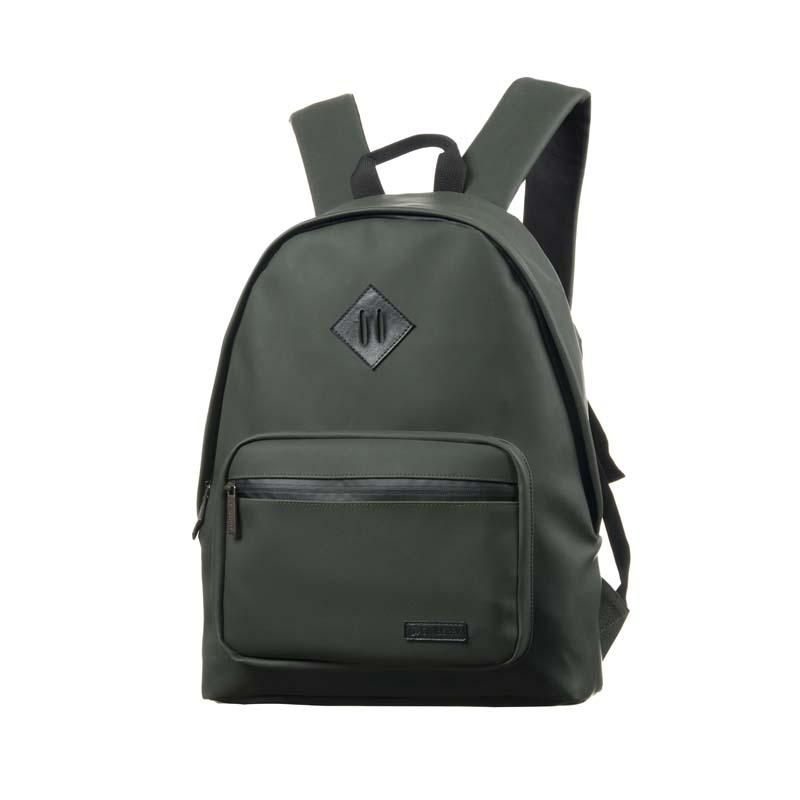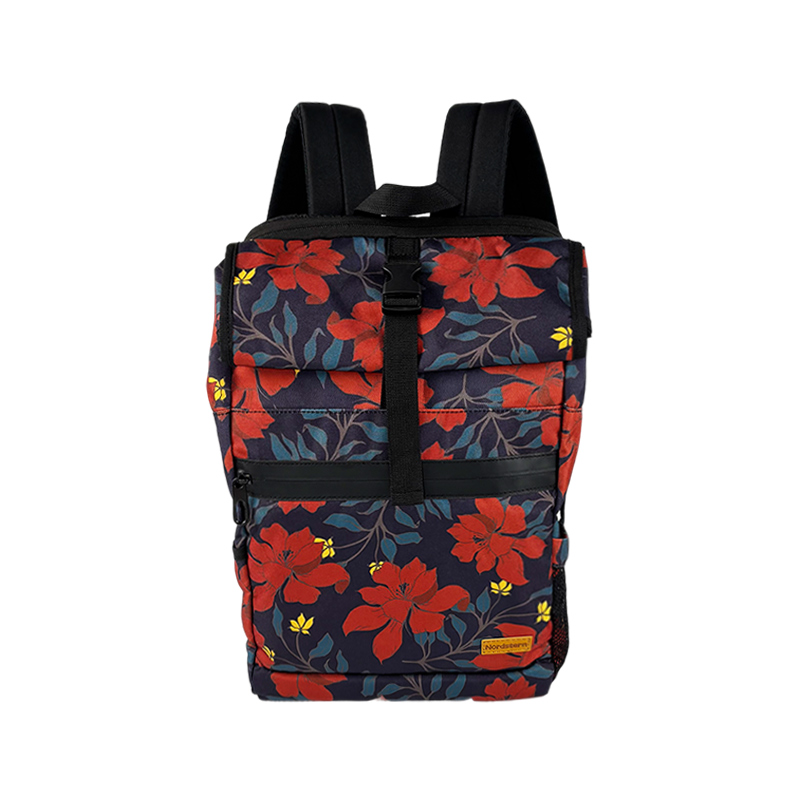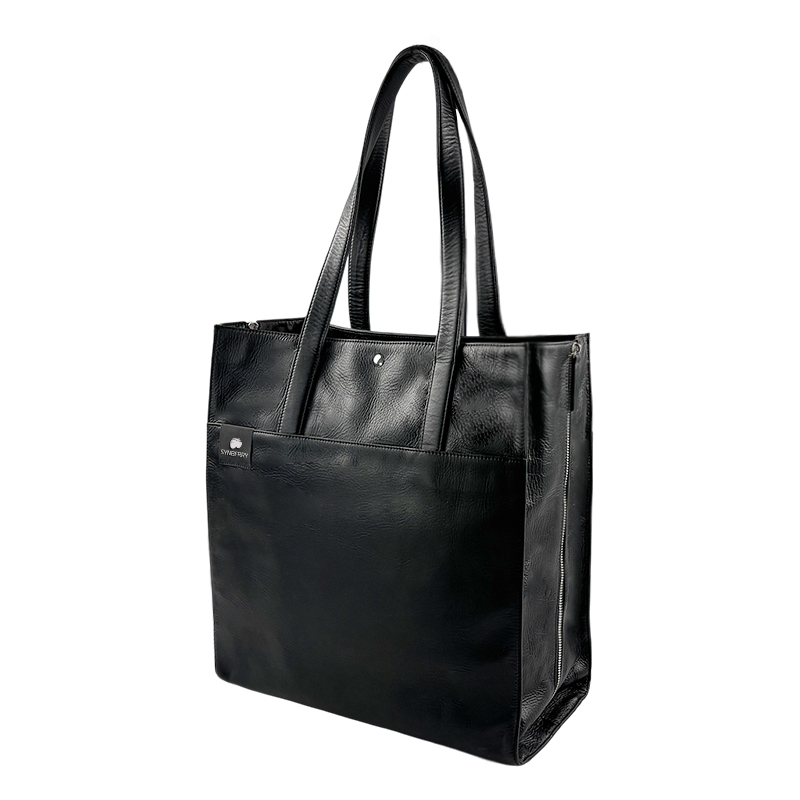




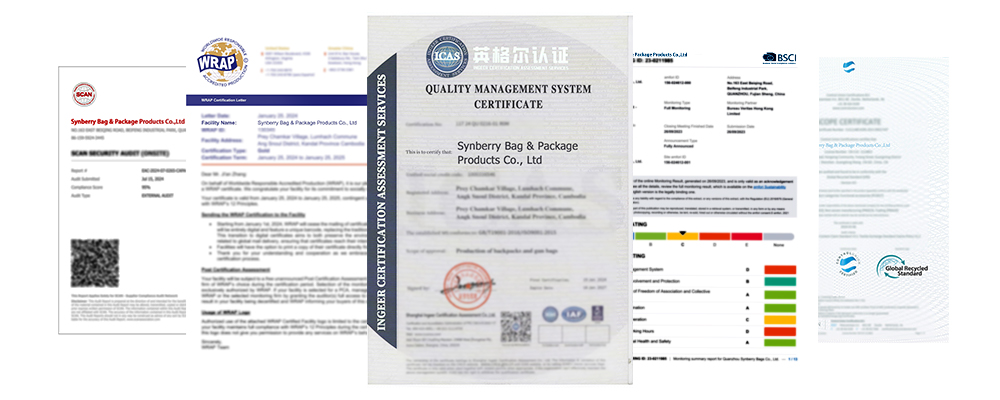
Synberry è certificato BSCI, WRAP, SCAN, GRS e ISO, garantendo standard di produzione sostenibili e di alta qualità.
Il nostro servizio professionale di personalizzazione del prodotto trasforma la tua idea in realtà, fornendo un'esperienza fluida dal concept all'esposizione del prodotto sullo scaffale del punto vendita


Con gli stabilimenti in Cina e Cambogia, hai la flessibilità di selezionare il sito di produzione che offre i vantaggi tariffari più vantaggiosi in base alla tua situazione specifica.

Cosa ha reso Synberry la scelta di due generazioni? Grazie a principi di qualità chiaramente definiti, documentazione e registri ben gestiti e, soprattutto, analisi e ispezioni approfondite dei processi, siamo in grado di garantire una qualità elevata e costante.

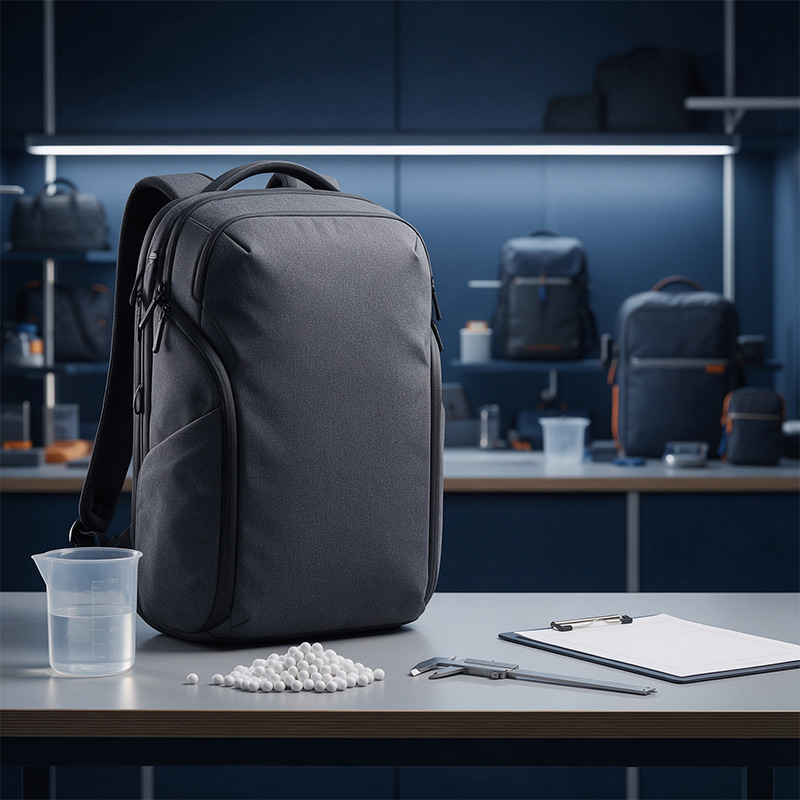
There are two widely used methods for measuring backpack capacity: geometric volume estimation and the ASTM F2153 fill test. During the design stage, the geometric formula (internal length × width × depth ÷ 1,000, multiplied by a pattern correction factor when necessary) can be used to estimate the maximum capacity. For sample approval and production capacity labeling, the unexpanded capacity measured using the ASTM F2153 fill test is generally used as the baseline. Geometric estimation is best suited to structured bags with regular shapes for preliminary space planning. Applying this method directly to sewn backpacks usually overestimates capacity. The fill test uses rigid plastic spheres with a diameter of 20 mm to fill all enclosed compartments; the spheres are then transferred to a calibrated measuring container to determine volume. The result can be used in purchase contracts, technical packs, inspection criteria, and product capacity labeling. For custom bag manufacturing, specifying the measurement method, included compartments, and tolerance alongside the capacity value helps align acceptance criteria between buyers and suppliers. Table of Contents Ⅰ. Why Backpacks with the Same Labeled Capacity Can Have Different Actual Volumes Ⅱ. Geometric Formula Estimation Ⅲ. ASTM F2153 Fill Test Ⅳ. Practical Recommendations for Backpack OEM Projects Ⅴ. Frequently Asked Questions (FAQ) Ⅵ. Conclusion Ⅰ. Why Backpacks with the Same Labeled Capacity Can Have Different Actual Volumes 1. Backpack Capacity Has No Globally Uniform Mandatory Labeling Standard Unlike shoe sizing or fabric weight, backpack capacity is not subject to a globally uniform mandatory labeling rule. Products labeled as 30 L may be measured using four common methods in the industry, producing different usable-volume results. Measurement method What is measured Typical result Notes Multiply external dimensions External length × width × height of the bag Likely to be overstated Counts fabric, foam, and back-panel structures as volume; unsuitable for labeled capacity. Main compartment only Largest enclosed main-compartment space Conservative Perceived usable space may exceed the labeled value, but the scope is limited and comparisons are less meaningful. Add all enclosed pockets Main compartment, zippered pockets, and covered enclosed pockets More comparable Closer to the logic of ASTM F2153; agree in advance whether open pockets are included. Promote expanded capacity Capacity with the roll-top or expansion zipper fully opened Represents maximum expanded state only Volume is lower in the normally closed state; some expanded bags may exceed airline carry-on limits. 2. Main Reasons for Differences in the Same Labeled Capacity For a daypack labeled 30 L, an external-dimension calculation includes space occupied by the back panel and shoulder-strap structure. Under the ASTM F2153 fill test, only enclosed compartments are counted; mesh water-bottle pockets and open front stash pockets are excluded. As a result, the unexpanded measured capacity may be only 24–25 L. Such differences are usually not manufacturing defects. They primarily result from different measurement methods and boundaries for what is included. 3. Capacity Must Be Matched to the Intended Use State Capacity can be reported as unexpanded capacity and expanded capacity. Unexpanded capacity refers to the bag in its normally closed, everyday-use configuration. Expanded capacity is the maximum volume available when a roll-top is fully opened or an expansion zipper is completely unzipped. A specification sheet that lists only one capacity value does not clearly identify the intended use state and makes inspection decisions more difficult. For roll-top bags and bags with expansion zippers, also verify the fully loaded external dimensions to determine whether the bag meets carry-on baggage size limits. Ⅱ. Geometric Formula Estimation 1. Basic Formula and Units A general geometric formula used in backpack OEM development is: Capacity (L) = Internal Length (cm) × Internal Width (cm) × Internal Depth (cm) ÷ 1,000 Example: With internal dimensions of 50 × 30 × 20 cm, the theoretical capacity is 50 × 30 × 20 ÷ 1,000 = 30 L. The formula uses centimeters and returns liters, based on 1 L = 1,000 cm³. For the North American market, capacity may also be listed in cubic inches; 1 L ≈ 61.024 cu in. 2. Appropriate Uses of the Geometric Formula • Reverse-engineering target dimensions during concept design: allocate internal usable dimensions based on the target capacity to support pattern and construction development. • Quickly estimating a capacity range during initial inquiries: when no physical sample is available, use external dimensions to make a preliminary assessment of the product category and support quotation and process evaluation. • Planning internal space before sampling: allocate space among the main compartment, laptop compartment, and front pockets, using the result as a theoretical upper-limit reference. 3. Why the Geometric Formula Can Be Inaccurate for Sewn Backpacks • The bag is not a perfect rectangular prism: daypacks that taper toward the top, roll-top bags, flap-top bags, and packs with curved suspension profiles have irregular shapes that cannot be accurately represented by a rectangular prism. • Fabric, foam, and suspension components reduce usable volume: laptop sleeves, back panels, and shoulder-strap anchor structures occupy space within the bag’s external profile. • Pocket-counting rules vary: external-dimension calculations may include side and front pockets, whereas standard fill testing counts enclosed compartments only and excludes open mesh pockets. • Seam allowances and lining thickness reduce usable space: sewing allowances, lining, and reinforcement materials reduce the effective internal volume. Conclusion: The geometric formula is a design-screening tool for estimating theoretical maximum volume; it should not be used directly as the labeled capacity of a sewn backpack. Results are more accurate for rectangular tote bags and simple travel duffels. For backpacks, technical outdoor packs, and styles with multiple complex compartments, capacity acceptance should be based on a fill test. 4. Early-Stage Estimation Before Sampling: Pattern Correction Factors During early development, before a physical sample is available, a pattern correction factor can help narrow the gap between theoretical and measured capacity. The adjusted formula is: Estimated capacity (L) ≈ [Internal length × internal width × internal depth (cm) ÷ 1,000] × K Select K according to the regularity of the bag’s shape. The ranges below are based on pattern databases and industry experience and are for design estimates only—not for official capacity labeling. The estimate must ultimately be calibrated against an ASTM fill test. Bag construction Reference correction factor Notes Boxy business backpack 0.80–0.85 Regular shape with high space efficiency. Standard daypack 0.75–0.80 Slightly contoured shape and space occupied by compartments. Outdoor hiking pack (internal aluminum-frame back panel) 0.70–0.75 Suspension system takes up more internal volume. Cylindrical duffel 0.72–0.78 Curved side walls reduce usable volume. Roll-top backpack 0.65–0.75 The rolled closure section is excluded from effective capacity. Tapered daypack, narrower at the top 0.70–0.78 The tapered cross-section makes the upper space less efficient. Example: A standard daypack with internal dimensions of 45 × 30 × 18 cm has a theoretical volume of 24.3 L. Using a correction factor of 0.78 gives an estimated capacity of approximately 19 L; subsequent fill testing will generally yield around 18–20 L. Important limitation: Correction factors are not universally transferable across factories or patterns. If the fabric weight or lining construction changes, re-test the bag and recalibrate K. In external technical communications, label this figure as a “design estimate,” not the contractual labeled capacity. Ⅲ. ASTM F2153 Fill Test 1. Standard Overview and Scope A commonly used industry standard for backpack capacity testing is ASTM F2153, “Standard Test Method for Measurement of Backpack Capacity.” It is a voluntary test method intended to establish consistent, comparable capacity-measurement rules among brands, factories, and inspection teams. Key principles: report both unexpanded and expanded capacity; count enclosed compartments only; exclude open mesh water-bottle pockets, open front stash pockets, and open compression pockets. The standard generally does not apply to small bags under 4 L. Crossbody mini bags, waist packs, and small organizers do not need to be labeled in liters; if a capacity value is provided, identify the alternative simplified test method used. 2. Standard Filling and Volume-Reading Procedure Step Procedure Control point 1. Prepare the test media Use uniform rigid plastic spheres with a diameter of 20 mm, commonly PP or PS. Foam beads and beans are for rough internal checks only; they compress or settle and have poor repeatability. Do not use them for official capacity labeling. 2. Fill all enclosed compartments Fill the main compartment and every zippered pocket. For roll-top bags, fill to the agreed number of rolls while ensuring normal closure. Close zippers after filling without pulling them taut. Do not omit any enclosed compartment. Exclude all open pockets. 3. Use a consistent settling procedure Gently shake the bag so the spheres settle naturally. A common procedure is three gentle shakes, approximately 10 seconds each. Do not deliberately press or compress the bag to inflate the reading. 4. Transfer the spheres to a calibrated measuring container Transfer all spheres into a graduated container calibrated by water-volume measurement. Gently agitate until the spheres settle, then record the volume. Large backpacks may be measured in multiple batches and the readings added together. Calibrate measuring equipment with water periodically and retain calibration records. 5. Repeat the test and average the results Conduct at least two independent tests. If the results differ by more than 1–2 L, filling or settling procedures may not have been consistent; repeat the test. Use the same spheres and measuring equipment for first-piece, in-line, and final inspections. 3. Limitations of the Standard and Its Relationship to Specification Sheets ASTM F2153 is voluntary and is not legally mandatory. Many retail product listings also omit the test method. The value of the test is that it allows the fill media, measuring equipment, included compartments, and tolerances to be defined in the specification sheet. If only a capacity number is listed without test details, results from different stages cannot be reliably compared. 4. When Full Laboratory Equipment Is Unavailable: Simplified Measurement Methods Not every inspection site has enough standard plastic spheres and calibrated measuring containers. A simplified method may be used during sampling, but the specification sheet must state that it differs from ASTM F2153. Scenario Simplified method Notes Compartments of 4 L or more Fill with 20 mm plastic spheres or uniform dry beans, then measure using a 1 L measuring cup and add the readings. Beans are for internal reference only; rigid plastic spheres are preferred for official capacity labeling. Compartments under 4 L Because small spheres stack with greater error, weigh the filling material first and convert to volume using a defined ratio if necessary. State in the documentation: “Not the ASTM F2153 standard procedure.” Curved or tapered bags Fill in vertical sections and add the readings from each section. A single rectangular-prism calculation will overestimate the capacity of tapered bags. Backpacks with multiple compartments Fill and measure each enclosed compartment separately, then total the results; list open pockets separately as excluded. Keep separate records to avoid confusion over what is included. Important: Capacity values obtained using different measurement methods should not be compared directly. Ⅳ. Practical Recommendations for Backpack OEM Projects 1. Recommended Capacity Fields for Specification Sheets To reduce the risk of a finished product’s capacity differing from expectations, include the following six items in the capacity section of the specification sheet: Field Recommended wording Purpose Measurement method “ASTM F2153 fill test using 20 mm PP spheres” / “Calculated from external dimensions; design reference only.” Identifies the method used to determine capacity. Unexpanded capacity Capacity in liters in the normally closed state. Matches typical use and product labeling. Expanded capacity Capacity in liters with the expansion zipper fully open or the roll-top fully unrolled. Distinguishes maximum expanded volume. Compartments included “Includes the main compartment and all zippered pockets; excludes mesh water-bottle pockets and open front stash pockets.” Removes ambiguity about which pockets count. Units List L and cu in together and specify the conversion. Supports reading preferences in different Western markets. Tolerance Agree on a tolerance by capacity range; use the same test method when judging compliance. Sets a reasonable acceptance range for inspection. 2. Example Wording for a Specification Sheet Capacity: 28 L unexpanded (approx. 1,709 cu in) / 34 L expanded (approx. 2,075 cu in), measured using the ASTM F2153 fill test with 20 mm PP plastic spheres. Includes the main compartment and all zippered pockets; excludes mesh water-bottle pockets and open front stash pockets. Tolerance: ±1.5 L. File the test record with the initial sample approval documents. 3. Suggested Tolerances and Contract Language Capacity range Suggested tolerance Application notes Under 20 L ±1 L Small bags are sensitive to compartment and opening design; test conditions must be controlled. 20–40 L ±1.5–2 L Common range for daypacks and commuter laptop backpacks. Over 40 L / large travel bags ±2–3 L Fill-test variation may be greater for large bags; additional repeats are recommended. Retail products with strict controls ±3%, or agree that “labeled capacity must not exceed measured unexpanded capacity.” Suitable for tightly controlled cross-border retail programs. Note: Tolerance criteria must correspond to the capacity test method. A tolerance established using external dimensions cannot be used to judge results from a fill test. 4. Common Capacity-Related Discrepancies in Custom Backpack Development Type of discrepancy Explanation Control measure Including open pockets in labeled capacity The counting method differs from ASTM and can produce inconsistent figures. Clearly list included and excluded pockets in the specification sheet. Advertising only expanded capacity Does not reflect volume in the product’s normally closed state. Provide both unexpanded and expanded capacity. Using external dimensions directly for sewn backpacks Foam, back panels, and lining take up space, so the calculated value is high. Use fill testing as the basis for labeled capacity; use external dimensions only as a supplementary reference. Using one capacity value for all sizes of a style Pattern and suspension structures change by size, affecting volume. Test each size independently. Testing only the first sample, with no production recheck Pattern adjustments, lining changes, and pocket revisions can change capacity. Test the approved reference sample and production trial units. Mixing metric and imperial units without labels Can lead to misinterpretation of readings. List both L and cu in in technical documents, with the primary unit suited to the target market. 5. Key Points When Comparing Multiple Samples Two products labeled with the same capacity may not perform equally in actual loading. Compare external dimensions, the main compartment’s internal usable dimensions, opening design, and photos of the bag when loaded. Even when both are labeled 30 L, a boxy pack and a tapered pack may accommodate different shapes of items. For travel backpacks and school backpacks, capacity is only one consideration. Flap-top designs are better suited to flat items, while top-loading roll-top bags offer good compression but can make items deep inside the bag harder to access. For a more complete assessment, include capacity, main-compartment internal dimensions, opening type, and fully loaded external dimensions in the specification sheet. 6. When to Conduct Capacity Tests Lock in the capacity baseline during initial sample approval. Once the first sample is complete, test capacity using the agreed method. After the parameters are approved, record them in the technical pack and purchasing documents before starting mass production. During inspection, use the same sphere specifications, measuring equipment, and settling procedure as for the approved sample, and assess the results against the agreed tolerance. 7. Capacity Records and Compliance Documentation Capacity testing is a technical specification activity and is separate from chemical testing of materials. Nevertheless, related records should be archived together for easy reference. If a product is labeled as using recycled fabric, the material claims should align with applicable GRS, GOTS, or OEKO-TEX documentation. Children’s backpacks sold in the United States must also meet applicable CPSIA requirements. A substantial discrepancy between labeled and measured capacity may create a risk of misleading advertising in the US and European markets. Store capacity test records and compliance certificates in the technical pack so they can be retrieved for customer factory audits and marketplace reviews. Ⅴ. Frequently Asked Questions (FAQ) Q1: Is backpack capacity accurately measured by multiplying length × width × height and dividing by 1,000? This formula estimates only the theoretical upper limit. It counts fabric, foam, and back-panel structures as volume and therefore generally overestimates usable space in sewn backpacks. The discrepancy is smaller for rectangular tote bags and simple travel duffels. For backpacks, outdoor packs, and styles with multiple compartments, capacity acceptance should be based on the ASTM F2153 fill test. A pattern correction factor can support early sampling estimates, but the result is for internal reference only and must not be used as the official labeled capacity. Q2: What is ASTM F2153? Are factories required to use it? ASTM F2153 is a voluntary test method for measuring backpack capacity; it is not legally mandatory. The core procedure is to fill all enclosed compartments with 20 mm rigid plastic spheres, transfer the spheres to a calibrated measuring container, and record both unexpanded and expanded capacity. Open water-bottle pockets and open stash pockets are excluded. The buyer and supplier should agree on whether to use the method in the technical documentation; once agreed, it becomes the basis for acceptance. Q3: Why does a factory label a backpack as 30 L when the fill-test result is only 25 L? This is usually due to differences in measurement methods—for example, using external dimensions or including open pockets in the calculation. A difference of around 20% between a daypack’s labeled capacity and its ASTM fill-test result is not unusual in the industry. Buyers and suppliers can establish a consistent basis for acceptance by agreeing in advance on the test method, pocket-inclusion rules, and tolerance range in the specification sheet. Q4: How should tolerances be set in a specification sheet, and which units should be used? For bags under 20 L, a tolerance of ±1 L is suggested; for 20–40 L, ±1.5–2 L; and for large bags over 40 L, ±2–3 L. For tightly controlled retail programs, the tolerance can be narrowed to ±3%, or the parties can agree that “the labeled capacity must not exceed the measured unexpanded capacity.” Use cubic inches (cu in) alongside liters for North America, while liters are generally preferred in Europe. Conversion: 1 L ≈ 61.024 cu in. Q5: How should capacity be tested for small bags under 4 L, waist packs, and organizers? ASTM F2153 generally does not apply to bags under 4 L. A simplified method can use a calibrated measuring cup, uniform dry beans, or a weight-to-volume conversion. The specification sheet must state that the method is “not the ASTM F2153 standard procedure.” Small spheres can stack inconsistently in small compartments, so external capacity claims for small bags should be made cautiously. Q6: Can rice or beans replace standard plastic spheres? They may be used for rough internal checks, but capacity figures used in contracts, specification sheets, or product labeling should not be based on rice or beans. Grains settle under pressure, and results vary between operators and batches, making repeatability poor. For formal testing, use 20 mm rigid PP/PS spheres and calibrated measuring equipment. Q7: For a roll-top backpack, how many rolls count as the unexpanded state under ASTM F2153? ASTM F2153 does not mandate a specific number of roll-top folds, which can lead to disagreement for this style. The buyer and supplier should agree in writing in the technical pack on the number of folds used for normal closure (commonly 2–3 rolls in the industry). Fill the bag to the agreed number of rolls and confirm that it closes normally without fabric tension; record this as the unexpanded capacity. The reading with the roll-top fully unrolled is the expanded capacity. Ⅵ. Conclusion From using geometric estimates to support early pattern planning, to determining labeled capacity through ASTM F2153 fill testing, and then specifying the test method, included compartments, and tolerances in clear technical terms, a verifiable capacity-assessment system is central to bag capacity management. Consistent criteria help project stakeholders avoid misunderstandings about specifications. As a professional bag manufacturer, we can support capacity-related technical requirements and help align project specifications with the agreed standards. Please contact us if you need assistance. Author
GUARDA DI PIÙ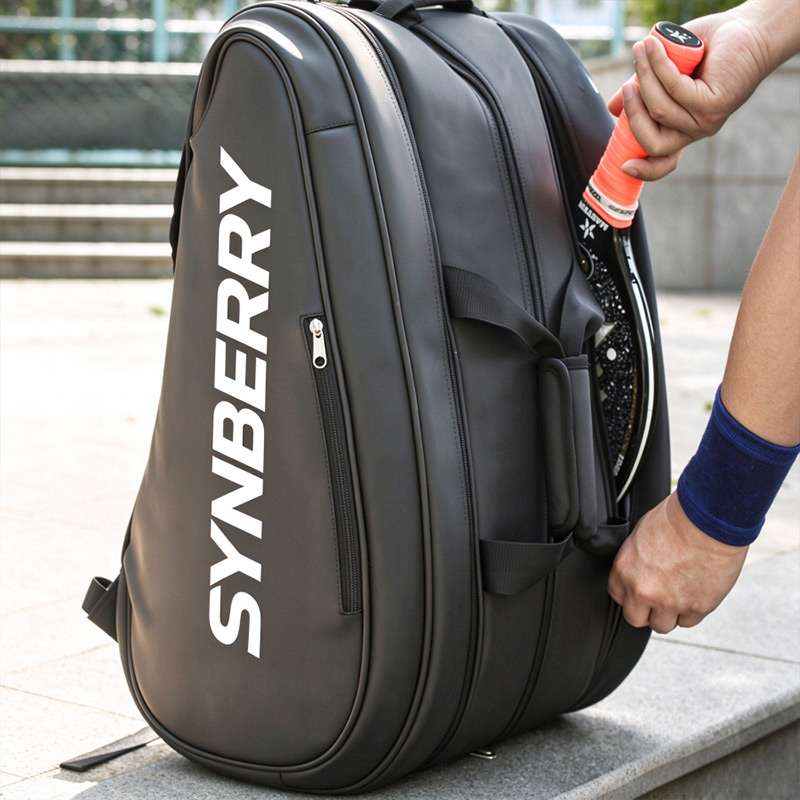
Una borsa da pickleball di qualità dovrebbe soddisfare quattro requisiti fondamentali: una disposizione degli scomparti scientificamente studiata, un sistema di trasporto comodo, una lavorazione di alta qualità e materiali resistenti e impermeabili. Solo quando tutti e quattro questi elementi sono combinati, una borsa da pickleball può essere considerata veramente valida.Sommario:Progettazione di compartimenti scientificiComodo sistema di trasportoLavorazione artigianale di alta qualitàMateriali durevoli e resistenti all'acquaConsigli di personalizzazione per i marchiDomande frequenti sulla personalizzazione delle borse da pickleballConclusione 1. Progettazione di compartimenti scientificiLe superfici delle racchette da pickleball sono realizzate principalmente in fibra di carbonio o materiali compositi in fibra di vetro, che sono sensibili alla pressione, ai graffi e all'esposizione prolungata ad alte temperature e alla luce solare diretta. Pertanto, uno scomparto dedicato per la racchetta è una caratteristica essenziale di una buona borsa da pickleball.Nello specifico, un ottimo vano per la pagaia dovrebbe avere le seguenti caratteristiche:Scomparto per pagaia ispessito e isolato: lo scomparto dedicato per la pagaia dovrebbe essere dotato di uno strato di imbottitura in EVA o cotone perlato ispessito per assorbire gli impatti quando la borsa viene lasciata cadere o schiacciata. Inoltre, un rivestimento isolante termico in lamina di alluminio resiste efficacemente alle alte temperature esterne e contribuisce a prevenire la deformazione della superficie della pagaia causata dalla prolungata esposizione alla luce solare diretta.Scomparto principale di grande capacità: lo scomparto principale deve offrire spazio sufficiente per contenere tutta l'attrezzatura essenziale necessaria per l'allenamento quotidiano o le competizioni, come abbigliamento, asciugamani, borracce e altri oggetti.Tasca per palline ad accesso rapido: aggiungi uno scomparto dedicato in rete o elastico all'interno dello scomparto principale per riporre le palline da pickleball. La tasca separata ad accesso rapido mantiene le palline fisicamente separate dagli indumenti, contribuendo a mantenere l'attrezzatura pulita e organizzata. Permette inoltre ai giocatori di accedere rapidamente alle palline di ricambio durante il riscaldamento o tra una partita e l'altra senza dover rovistare nell'intero scomparto principale, migliorando l'efficienza complessiva e l'esperienza d'uso.Scomparto separato e ventilato per le scarpe: isolato dallo scomparto principale, impedisce che scarpe bagnate o sporche contaminino racchette e indumenti, contribuendo al contempo a ridurre gli odori sgradevoli. Questa è una caratteristica fondamentale che distingue una borsa da pickleball professionale da una normale borsa da palestra.Molteplici piccole tasche: progettate per riporre oggetti personali e accessori come cellulari, chiavi, impugnature, protezioni e asciugamani.Tasca nascosta per oggetti di valore: dotata di un interno morbido foderato in pelle scamosciata per riporre in sicurezza oggetti di valore che potrebbero graffiarsi. 2. Comodo sistema di trasportoLe borse da pickleball sono generalmente disponibili in tre versioni: zaini, borse a tracolla/a spalla e borse convertibili che possono essere portate a mano o indossate come zaini. Zaino: ideale per trasportare più pagaie e un set completo di attrezzatura, le sue caratteristiche principali risiedono nel design degli spallacci e del pannello posteriore. Gli spallacci di uno zaino di alta qualità dovrebbero essere larghi e spessi, imbottiti con schiuma ad alta densità e rivestiti in tessuto a rete traspirante per distribuire la pressione sulle spalle e favorire la circolazione dell'aria, prevenendo un eccessivo accumulo di calore e segni di pressione durante un utilizzo prolungato. Il pannello posteriore dovrebbe incorporare uno strato di supporto in EVA o cotone perlato PE per evitare che si deformi o si afflosci sotto carichi pesanti. Dovrebbe inoltre adattarsi alla curvatura naturale della colonna vertebrale, fornendo un supporto stabile e affidabile.Borse a tracolla o a spalla: queste borse privilegiano leggerezza, praticità e flessibilità, risultando ideali per brevi sessioni di allenamento o situazioni in cui è necessario portare con sé solo una piccola quantità di equipaggiamento. La tracolla deve essere sufficientemente larga da evitare che scivoli, mentre l'imbottitura della spalla deve includere uno strato ammortizzante per ridurre lo sforzo derivante dal trasporto del peso su una sola spalla. Una tracolla regolabile consente a persone di diverse altezze di trovare una posizione comoda.Borsa convertibile e zaino: per chi apprezza la versatilità, una borsa convertibile e uno zaino offrono maggiore flessibilità. Questo tipo di borsa è generalmente dotato di un manico superiore rinforzato per un comodo trasporto su brevi distanze o per riporla in auto, nonché di un manico laterale imbottito progettato per ridurre la pressione sulla mano e prevenire fastidi durante il trasporto.Quando trasformato in zaino, gli spallacci a scomparsa devono essere facili da estrarre e fissare saldamente, garantendo un'esperienza di trasporto fluida in entrambe le configurazioni. Indipendentemente dallo stile scelto, l'obiettivo finale del sistema di trasporto è quello di garantire che i giocatori si sentano comodi e a proprio agio durante gli spostamenti da e per il campo. 3. Lavorazione artigianale di alta qualitàLa cura dei dettagli nella lavorazione determina direttamente la durata e l'aspetto generale di una borsa da pickleball.Cucitura: La cucitura deve essere forte e resistente, con spaziatura uniforme dei punti e cuciture ordinate e uniformi. I punti di stress principali, come i punti di attacco della tracolla, le basi delle maniglie e le estremità della cerniera, devono essere rinforzati con doppie o addirittura triple cuciture, combinate con punto di rinforzo Rinforzi per migliorare la resistenza allo strappo e impedire che le cuciture si spacchino o si rompano sotto carichi pesanti prolungati.Componenti metallici: La scelta dei componenti metallici è fondamentale. Le cerniere devono essere scorrevoli, resistenti e offrire un certo livello di impermeabilità, preferibilmente di marchi rinomati come YKK o SBS. I tiranti delle cerniere devono essere progettati per una presa e un utilizzo agevoli, anche indossando guanti sportivi.Fibbie: Le fibbie devono essere sottoposte a test di fatica per garantire che resistano a crepe o deformazioni anche dopo ripetuti allacciamenti e slacciamenti. Inoltre, i bordi del tessuto devono essere rifiniti con cura, senza fili sporgenti, e la borsa deve mantenere una forma strutturata e ben definita senza afflosciarsi facilmente, anche quando è vuota. Questi dettagli riflettono la qualità professionale e la cura per i particolari. 4. Materiali resistenti e impermeabiliIl pickleball si gioca spesso all'aperto, dove le borse possono essere esposte a improvvisi acquazzoni o alla rugiada mattutina sul campo. Pertanto, l'impermeabilità del tessuto rappresenta la prima linea di difesa per proteggere l'attrezzatura al suo interno. 4.1 Tessuto principale: Nylon vs. PoliestereUna borsa da pickleball di alta qualità dovrebbe essere realizzata in nylon ad alta densità (come 600D o superiore) o in tessuto di poliestere. Questi materiali offrono un'eccellente resistenza all'abrasione e allo strappo, oltre a buone proprietà idrorepellenti.Nylon: Confrontando questi due materiali comuni, il nylon si distingue per il suo elevato rapporto resistenza-peso e l'eccellente resistenza all'abrasione, caratteristiche che lo rendono la scelta preferita per le borse da pickleball di alta qualità. Ha una superficie liscia e una consistenza morbida, ma un costo relativamente più elevato.Poliestere: Il poliestere offre una migliore resistenza ai raggi UV e una maggiore tenuta del colore, risultando meno soggetto a sbiadimento o deterioramento dopo una prolungata esposizione alla luce solare diretta. È inoltre più economico, il che lo rende una scelta conveniente. 4.2 Rivestimenti impermeabiliUn tessuto di base di alta qualità da solo non è sufficiente a resistere a condizioni atmosferiche avverse. Il trattamento impermeabilizzante della superficie è il fattore chiave che determina le prestazioni idrorepellenti di una borsa. La maggior parte delle borse da pickleball professionali attualmente in commercio utilizza uno dei tre trattamenti principali: rivestimento DWR (idrorepellente a lunga durata), rivestimento in PU o rivestimento in TPU.Idrorepellenza DWR: il rivestimento DWR crea un effetto a foglia di loto sulla superficie della borsa, facendo sì che le gocce d'acqua si raccolgano e scivolino via rapidamente anziché penetrare nel tessuto. Ciò impedisce efficacemente all'acqua piovana di inzuppare l'attrezzatura all'interno.Rivestimento impermeabile in PU: il rivestimento in PU viene generalmente applicato sul lato interno del tessuto, formando una membrana impermeabile densa. Non solo impedisce la penetrazione dell'umidità esterna, ma migliora anche la struttura complessiva del tessuto e la sua resistenza allo strappo.Rivestimento impermeabile in TPU: Il rivestimento in TPU, un elastomero poliuretanico termoplastico, viene in genere laminato sul lato interno del tessuto come una pellicola sottile o incorporato come strato separato. Rispetto al rivestimento in PU, il TPU offre una maggiore resistenza all'idrolisi e flessibilità alle basse temperature. Anche in ambienti freddi e umidi, è meno soggetto a degradazione, indurimento o screpolature, contribuendo a mantenere l'impermeabilità della borsa nel tempo. 5. Raccomandazioni di personalizzazione per i marchiSe state pensando di sviluppare una borsa da pickleball con il vostro marchio, i seguenti consigli, relativi a tre aree chiave, possono aiutarvi a trovare il giusto equilibrio tra prestazioni del prodotto, costi e pubblico di riferimento. 5.1 Raccomandazioni per la selezione del tessuto principaleIl tessuto determina l'aspetto, la sensazione al tatto, la durata e il potenziale di prezzo di una borsa da pickleball. La tabella seguente fornisce raccomandazioni sulla scelta del tessuto in base al posizionamento del prodotto.Opzione tessutoSpecifiche comuniResistenza / Resistenza all'abrasioneResistenza ai raggi UVCostoPosizionamento consigliatoPoliestere600D / 900D★★★☆★★★★☆ (resistente allo sbiadimento)ModerareModelli convenienti, modelli base e prodotti per un'esposizione prolungata al sole all'aperto.NylonNylon balistico 600D / 1680D★★★★★ (forte e leggero)★★★ (Si consiglia il trattamento con raggi UV)Da medio ad altoModelli e borse di fascia medio-alta per giocatori professionistiNylon + Ripstop / JacquardNylon a scacchi, trama a nido d'ape★★★★★★★★AltoModelli di alta gamma e marchi di designTessuto a rete composito (PVC/EVA)500D–1000D★★★★☆★★★☆ModerareModelli e borse impermeabili migliorati, ideali per la spiaggia o per usi multipli.Principali considerazioni da tenere presenti durante la selezione:Per i modelli ad alto volume di vendita, è preferibile il poliestere 600D. Offre costi contenuti e una buona resistenza del colore, il che lo rende una scelta popolare per i prodotti di fascia bassa e di largo consumo.Per i modelli di fascia medio-alta, si consiglia di prendere in considerazione il nylon balistico 1000D o 1680D. La sua elevata resistenza e la buona impermeabilità lo rendono adatto al mercato di fascia medio-alta.Opzioni ecocompatibili: prendete in considerazione il nylon riciclato, come ECONYL®, o il poliestere riciclato (RPET), e sostenete le certificazioni riconosciute a livello internazionale come GRS per soddisfare la crescente domanda di prodotti sostenibili nei mercati europei e nordamericani. 5.2 Raccomandazioni per la selezione della capacitàQuando si parla di capacità, più grande non è sempre sinonimo di migliore. La dimensione ideale dovrebbe essere adeguata agli scenari di gioco e alle abitudini di trasporto degli utenti target. La tabella seguente fornisce raccomandazioni sulla progettazione della capacità per lo sviluppo di borse da pickleball OEM.Categoria di capacitàCapacità della pagaiaConfigurazione tipicaPubblico di riferimentoDimensioni di riferimento (L × P × A)Modello leggero1–2 pagaieScomparto principale + tasca per palloni + portaborraccia; solitamente senza scomparto per le scarpe.Giocatori occasionali e persone che uniscono le passeggiate al gioco del pickleballCirca 45 × 20 × 25 cmModello standard (consigliato)2–4 pagaieScomparto imbottito per pagaia + scomparto principale + scomparto separato per scarpe + tasca per palline + scomparti per piccoli oggettiSoci del club e giocatori abituali di doppioCirca 50 × 25 × 32 cmModello professionale di grande capacità4–6 pagaieScomparto imbottito per pagaia + ampio scomparto principale + scomparto separato per scarpe + tasca per palloni + custodia impermeabileGiocatori e allenatori professionistiCirca 55 × 30 × 38 cmModello di viaggio/team6 o più pagaieValigia con ruote o zaino extra-large con sistemi di fissaggio esterni.Acquisti di gruppo e giocatori che viaggiano frequentementeCirca 60 × 35 × 45 cmPrincipali considerazioni da tenere presenti durante la selezione:Il modello standard è la soluzione ideale. Una borsa che può contenere da 2 a 4 racchette è adatta a un'ampia gamma di giocatori. I marchi che sviluppano una nuova linea di borse per pickleball dovrebbero considerare di rendere questa capacità il loro prodotto di punta.I modelli leggeri sono ideali per l'acquisizione di clienti o come omaggi promozionali. La loro struttura semplice e il costo contenuto li rendono adatti come borse da abbinare ai set base o come regali commemorativi per eventi di club, abbassando la soglia d'ingresso per i nuovi giocatori.I modelli professionali di grande capacità dovrebbero privilegiare l'efficienza dello spazio di archiviazione piuttosto che la semplice aggiunta di ulteriore spazio. Per affrontare la sfida di organizzare la vasta attrezzatura portata da allenatori e giocatori professionisti, è consigliabile considerare divisori rimovibili o scomparti interni modulari. Queste caratteristiche consentono agli utenti di riporre diverse combinazioni di racchette e abbigliamento mantenendo l'interno in ordine.I modelli da viaggio/squadra dovrebbero privilegiare le caratteristiche pensate per il trasporto. Oltre a una capienza extra-large, dovrebbero includere una cinghia standard per il fissaggio al bagaglio e piedini protettivi resistenti all'abrasione. Queste caratteristiche aiutano a fissare la borsa da pickleball alla valigia durante i trasferimenti aeroportuali e i viaggi a lunga distanza, riducendo al contempo l'usura del fondo della borsa. 6. FAQ: Domande frequenti sulla personalizzazione delle borse da pickleball D1: Qual è la differenza tra una borsa da pickleball e una borsa da tennis? Possono essere utilizzate indifferentemente?Possono essere utilizzate temporaneamente in modo intercambiabile, ma non è consigliato. Le racchette da pickleball (lunghe circa 40 cm) sono più corte delle racchette da tennis, quindi gli scomparti delle racchette da tennis potrebbero lasciare troppo spazio vuoto, permettendo alle racchette di spostarsi e urtare contro altri oggetti. Le borse da pickleball in genere dispongono anche di tasche dedicate per le palline, poiché le palline da pickleball in plastica rigida possono danneggiarsi a causa di una pressione eccessiva, oltre a scomparti per le scarpe e altri piccoli scomparti per riporre oggetti. Se giochi solo a pickleball, una borsa specifica per questo sport offre un'esperienza d'uso decisamente migliore. D2: Come posso capire il grado di impermeabilità di una borsa? La repellenza all'acqua significa che è impermeabile?No. L'idrorepellenza offerta da un rivestimento DWR è generalmente sufficiente per pioggia leggera e schizzi, ma le zone delle cerniere possono comunque permettere all'acqua di infiltrarsi. Per una protezione impermeabile più completa, la borsa necessita di una combinazione di tessuto rivestito in PU/TPU o tessuto impermeabile laminato e cerniere impermeabili, come quelle della serie di cerniere impermeabili YKK. Al momento dell'acquisto, verifica che le specifiche del prodotto menzionino sia il rivestimento del tessuto che le cerniere impermeabili. D3: Perché il vano portaoggetti di una racchetta da pickleball necessita di isolamento termico? Il caldo estivo può davvero danneggiare una racchetta?Sì. Le racchette da pickleball con superficie in fibra di carbonio o fibra di vetro e anima a nido d'ape in polipropilene possono subire rammollimento, delaminazione o alterazioni nella sensazione di gioco dopo un'esposizione prolungata ad alte temperature e alla luce solare diretta. Un rivestimento isolante termico in lamina di alluminio può ridurre significativamente la temperatura all'interno della borsa, rappresentando una delle caratteristiche chiave che distinguono una borsa da pickleball professionale da un modello economico. D4: Qual è la quantità minima d'ordine (MOQ) e il tempo di consegna tipici per le borse da pickleball personalizzate?Il quantitativo minimo d'ordine (MOQ) standard di SYNBERRY è di circa 500 pezzi. I tempi di consegna per la campionatura dipendono dalla complessità del design e sono in genere di 2-3 settimane. I tempi di consegna per la produzione di massa variano in base alla quantità dell'ordine e alla complessità della produzione. È necessario prevedere tempi aggiuntivi per processi speciali, come la stampa a superficie completa, le strisce riflettenti e le fibbie stampate su misura. D5: Devo scegliere nylon o poliestere per una borsa da pickleball? Quale dei due è più resistente?Entrambi i materiali sono resistenti, ma ognuno offre vantaggi diversi. Il nylon garantisce maggiore robustezza e una migliore sensazione al tatto, risultando adatto a prodotti di fascia medio-alta. Il poliestere offre una migliore resistenza ai raggi UV, una maggiore tenuta del colore e un prezzo inferiore, il che lo rende ideale per modelli economici destinati a un'esposizione prolungata al sole. Scegli il nylon se il tuo budget lo consente; scegli il poliestere se il rapporto qualità-prezzo è la tua priorità. 7. ConclusionIl pickleball sta vivendo una crescita esponenziale a livello globale e le borse da pickleball si stanno evolvendo da semplici accessori a vera e propria categoria di prodotto specializzata. Per i marchi di borse sportive, questo rappresenta non solo un'opportunità per entrare in un mercato emergente, ma anche un momento cruciale per consolidare la notorietà del marchio a livello professionale attraverso lo sviluppo di prodotti più raffinati.Una borsa da pickleball di qualità dovrebbe essere molto più di un semplice insieme di scomparti. Dovrebbe riflettere una profonda comprensione delle esigenze dell'utente finale e offrire una risposta ponderata alle sue aspettative. Dalla tecnologia di isolamento termico che protegge le racchette costose, alla disposizione degli scomparti che migliora l'accesso, fino ai materiali resistenti alle intemperie progettati per l'uso esterno, ogni dettaglio dimostra rispetto per l'esperienza sportiva del giocatore.Questo articolo è stato scritto dal punto di vista di un produttore di borse per pickleball, con l'obiettivo di fornire ai marchi che sviluppano linee di prodotti per pickleball una guida di riferimento completa, dalla comprensione delle esigenze del cliente fino alla messa in produzione dei prodotti. Autore
GUARDA DI PIÙ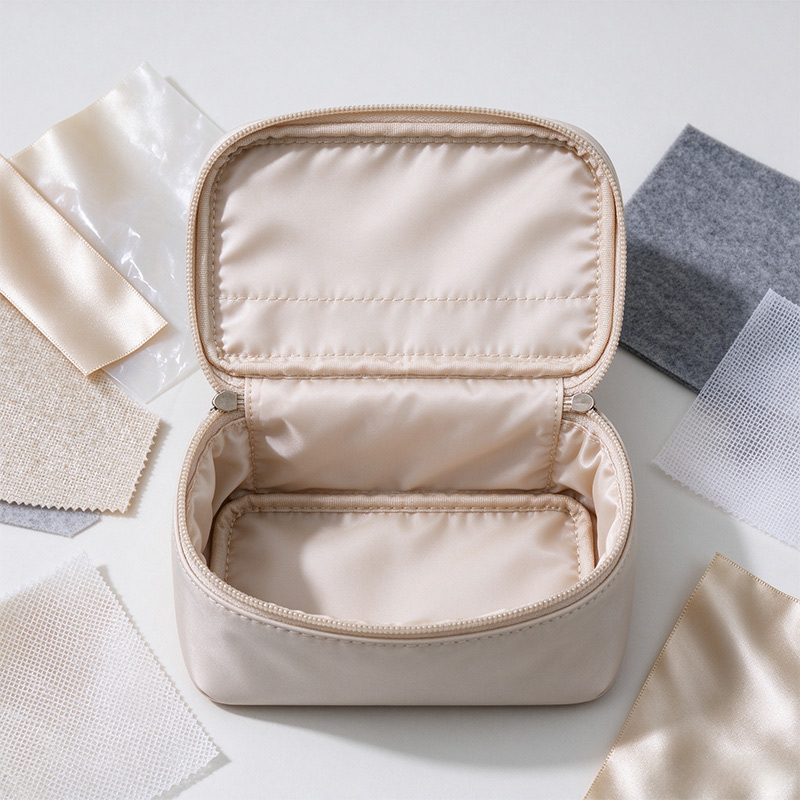
I materiali più comunemente utilizzati per la fodera delle trousse cosmetiche sono tessuti a base di poliestere, in particolare poliestere a trama semplice, taffetà di poliestere, pongee e poliestere spalmato. Inoltre, nylon, TPU, PEVA, PVC ed EVA sono spesso utilizzati per prodotti con elevati requisiti di impermeabilità e tenuta stagna; il poliestere riciclato RPET e il nylon riciclato sono adatti per le linee di marchi sostenibili; microfibra, finta pelle scamosciata, velluto e raso sono adatti per una sensazione tattile di alta gamma e per il posizionamento come prodotto regalo. Cotone, tela, misto cotone-poliestere e misto cotone-lino possono essere utilizzati anche per la fodera delle trousse, soprattutto per quelle in tela, per uno stile naturale, per un posizionamento ecocompatibile o per prodotti che richiedono una texture ricamata. Tuttavia, le loro prestazioni in termini di impermeabilità, resistenza alle macchie e facilità di pulizia differiscono in genere da quelle dei tessuti sintetici rivestiti e devono essere valutate in base a specifici scenari di utilizzo. Sommario:• Selezione in base ai requisiti funzionali• Parametri tecnici chiave per la selezione del rivestimento• Processi di personalizzazione del rivestimento e metodi di presentazione del logo• Come garantiamo il controllo qualità completo dei materiali durante l'intero processo produttivo per i nostri marchi?• Domande frequenti• Conclusion I. Selezione in base ai requisiti funzionali e analisi dei tessuti più comuniLa scelta del rivestimento interno per le trousse cosmetiche si basa in genere su criteri quali resistenza alle macchie e impermeabilità, protezione dei cosmetici, facilità di pulizia e mantenimento della forma. La sezione seguente classifica i tessuti in base ai requisiti funzionali e ne illustra le caratteristiche, gli scenari di applicazione e le precauzioni da adottare per i tessuti più comunemente utilizzati. 1. Categoria impermeabile e facile da pulire• Pellicola in PVC/TPU: comunemente utilizzata per borse cosmetiche funzionali e scomparti per la separazione tra asciutto e bagnato, con eccellenti prestazioni di impermeabilità e tenuta stagna. I liquidi si puliscono facilmente in caso di schizzi. Il PVC offre eccellenti prestazioni di impermeabilità e trasparenza, ma i rischi di conformità ai sensi del REACH e della Prop 65 devono essere attentamente valutati per i mercati europei e americani; il TPU offre prestazioni complessivamente migliori in termini di ecocompatibilità, resistenza ai raggi UV e flessibilità, il che lo rende la scelta preferita per i modelli impermeabili di alta gamma.• PEVA: Privo di cloro, rappresenta un'alternativa ecocompatibile al PVC, offrendo buone prestazioni di impermeabilità e facilità di pulizia, risultando adatto a marchi con esigenze di sostenibilità. L'esposizione prolungata ai raggi UV può causare un leggero ingiallimento, che deve essere valutato in fase di campionamento.• EVA: Comunemente utilizzato per vassoi interni rigidi o rivestimenti stampati, con buone prestazioni di impermeabilità e supporto strutturale, adatto per anime interne di borse cosmetiche che richiedono il mantenimento della forma.• Poliestere rivestito e tessuto Oxford rivestito (ad es. rivestimento in PU, rivestimento in TPU): dopo l'applicazione di un rivestimento al poliestere o al tessuto Oxford, si forma una pellicola continua sulla superficie della fodera, bloccando efficacemente la penetrazione di liquidi come fondotinta liquido e creme idratanti. Resistente all'usura e agli strappi, con un buon rapporto qualità-prezzo, adatto per trousse di grande capacità a prezzi accessibili e per modelli funzionali di uso quotidiano. Si noti che i rivestimenti e le cuciture non sono assolutamente a tenuta stagna.• Tessuto in poliestere a trama semplice, pongee, taffetà di poliestere: fornitura stabile, elevata efficienza di taglio e cucitura e solidità del colore, garantendo uniformità del colore della fodera tra lotti diversi in ordini all'ingrosso. Tra questi, il taffetà di poliestere è leggero e ad alta densità, liscio e resistente agli strappi; il pongee e il tessuto a trama semplice sono adatti per modelli destinati al mercato di massa. Per esigenze di impermeabilità di base, è possibile scegliere versioni con rivestimento leggero.• Taffetà di nylon: piacevole al tatto, resistenza allo strappo superiore al poliestere con le stesse specifiche, adatto per trousse di fascia medio-alta. Il nylon possiede di per sé alcune proprietà impermeabili ed è comunemente utilizzato per fodere impermeabili e facili da pulire. Se il prodotto privilegia leggerezza, resistenza e praticità per i viaggi, il nylon è una scelta da prendere in considerazione.[Nota aggiuntiva] I tessuti rivestiti resistono solo agli schizzi. La cucitura normale crea fori d'ago e i liquidi potrebbero comunque infiltrarsi attraverso le cuciture. Se è necessaria una completa impermeabilizzazione, è richiesto un ulteriore processo di termosaldatura delle cuciture. 2. Categoria di mantenimento della forma e ammortizzazione• Feltro: Elevata rigidità, forte sostegno, aiuta la trousse a mantenere una silhouette tridimensionale e fornisce un certo effetto ammortizzante e di assorbimento degli urti, adatto per borse interne personalizzate e prodotti che necessitano di proteggere ciprie compatte e palette di ombretti. Occorre prestare attenzione al peso, ai metodi di pulizia e allo spessore.• Categoria in pile (ad es. pile in microfibra, finta pelle scamosciata, velluto): tocco delicato, con una leggera sensazione di assorbimento degli urti, può ridurre lo scivolamento e i graffi dei flaconi di cosmetici, adatto per trousse di fascia medio-alta. Microfibra, finta pelle scamosciata e velluto offrono una sensazione tattile di alta qualità e proprietà antiscivolo, utilizzati principalmente per abbinamenti con marchi di lusso.3. Categoria di texture di alta gamma• Acetato satinato: morbido e liscio al tatto, lucentezza calda, buona vestibilità e resistenza alle pieghe, scorrevole per prelevare e riporre i cosmetici, non impiglia le setole dei pennelli da trucco, adatto per un posizionamento di lusso leggero.• Raso/Sateen ordinario: superficie liscia, delicata sulla pelle, con una lucentezza tenue, può esaltare la raffinatezza, adatto per regali e prodotti che valorizzano il design visivo. È necessario valutare la resistenza agli strappi, all'abrasione e la solidità del colore. Il raso di poliestere e il raso di nylon offrono eccellenti effetti di stampa, adatti per fodere di alta gamma.4. Categoria Eco-riciclata e sostenibile• RPET: Realizzato con bottiglie in PET riciclate tramite frantumazione, pulizia e filatura. La sua consistenza, la solidità del colore e la resistenza all'abrasione differiscono solo minimamente da quelle del poliestere vergine e può sostituire senza problemi il tradizionale poliestere a trama semplice o il taffetà, risultando adatto alla maggior parte delle fodere per trousse cosmetiche convenzionali. È un materiale comunemente utilizzato dai marchi che adottano principi ESG.• Nylon riciclato: derivato principalmente da reti da pesca dismesse, fibre di tappeti e altri rifiuti industriali, rigenerato tramite depolimerizzazione e polimerizzazione. Rispetto al RPET, il nylon riciclato offre prestazioni migliori in termini di resistenza, elasticità e resistenza chimica, con una sensazione al tatto più delicata e liscia, ma l'offerta sul mercato è meno stabile rispetto al RPET e il costo è generalmente superiore.5. Categoria Stile Naturale e Misto• Cotone: Sensazione al tatto naturale, delicato sulla pelle, assorbente, adatto a uno stile naturale, posizionamento ecologico e fodere per trousse in tela.• Tela: Grammatura più elevata, buon supporto strutturale, resistente all'usura, adatta per borse cosmetiche in tela, trousse da toilette, fodere per borse da viaggio o tasche esterne. Quando utilizzata come fodera, è necessario valutare attentamente peso, spessore e processi di cucitura. La tela di puro cotone è traspirante e leggera, adatta per prodotti in polvere, pennelli per il trucco e altri articoli che necessitano di ventilazione.Il cotone e la tela comuni non sono impermeabili, assorbono facilmente colore e macchie. Se esposti direttamente a cosmetici liquidi, la pulizia risulta difficile. Un approccio comune consiste nell'utilizzare sacchetti interni rimovibili e lavabili, finiture con rivestimento, sacchetti impermeabili indipendenti o strutture con scomparti interni. • Misto cotone-poliestere: bilancia la naturale sensazione al tatto del cotone con la resistenza e la stabilità dimensionale del poliestere, ideale per progetti che richiedono un equilibrio tra consistenza e uniformità nella produzione in serie.• Misto cotone-lino: Caratterizzato da una texture naturale pronunciata, adatto a marchi di stile specifici, ma la resistenza alle macchie e la solidità del colore devono essere verificate in fase di campionatura.6. Altre categorie pratiche• Fodera in PU: Testurizzata, facile da pulire, adatta per gli spostamenti quotidiani e per prodotti di fascia media. La sua superficie è densa e blocca efficacemente la penetrazione di macchie a base oleosa come fondotinta liquido e rossetto. Si pulisce facilmente con un panno umido, con bassi costi di manutenzione. Si consiglia di scegliere materiali in PU con una buona resistenza all'idrolisi per evitare lo scrostamento o l'appiccicosità del rivestimento dopo un uso prolungato, soprattutto in ambienti ad alta temperatura e umidità dove sono richiesti test di invecchiamento.• Rete/Rete a tre strati: eccellente traspirabilità, leggerezza, comunemente utilizzata per le borse interne o gli strati per riporre i pennelli nelle trousse per cosmetici, facilitando la rapida identificazione degli articoli e accelerando la dissipazione dell'umidità interna, riducendo il rischio di formazione di muffa. Tuttavia, a causa della sua superficie irregolare e dei pori di grandi dimensioni, trattiene facilmente lo sporco ed è difficile da pulire a fondo. Non è raccomandata come rivestimento principale a diretto contatto con cosmetici liquidi e di solito deve essere utilizzata con una borsa interna impermeabile.II. Parametri tecnici chiave per la selezione del rivestimentoNella scelta dei tessuti di rivestimento per le trousse cosmetiche, i seguenti parametri influiscono direttamente sulla qualità del prodotto finale e sull'esperienza d'uso. Si consiglia di verificare ogni elemento durante la fase di campionatura. 1. Peso in grammi e spessore• Grammatura ridotta (ad esempio, taffetà di poliestere o pongee da 30-50 g/m²): leggero e morbido, massimizza lo spazio interno, riduce il peso complessivo, adatto per trousse da viaggio che ricercano la massima portabilità e leggerezza.• Grammatura media (ad esempio, poliestere, nylon o cotone a trama semplice da 60-100 g/m²): offre un buon equilibrio tra morbidezza al tatto e resistenza, ed è la scelta più comune per la maggior parte delle trousse per cosmetici. I tessuti di questa gamma presentano una rigidità moderata, mantengono la forma di base della borsa, garantendo al contempo una buona stabilità delle cuciture e resistenza all'abrasione, risultando adatti per gli spostamenti quotidiani e per diverse esigenze di stoccaggio.• Grammatura elevata (ad esempio, tela spessa da 120 g/m² o superiore, tessuto spalmato ispessito o feltro composito): eccellente rigidità e supporto strutturale, che mantengono efficacemente la forma tridimensionale della trousse, prevenendo la deformazione dovuta alla compressione interna degli oggetti; comunemente utilizzata per trousse rigide o per design interni che devono rimanere in piedi da soli. 2. Tipo di rivestimento e prestazioni di impermeabilitàTipo di rivestimentoPrestazioni di impermeabilitàResistenza all'abrasioneRispetto dell'ambienteApplicazione tipicaRivestimento in PUBeneBeneMezzoPochette per cosmetici di tutti i giorniComposito TPUEccellenteEccellenteEccellenteModelli impermeabili di alta gammaPEVABeneMezzoBenestili di posizionamento ecocompatibiliPVCEccellenteBeneLa conformità richiede un'attenta valutazioneStili trasparentiEVABeneBene MezzoVassoi interni stampati, rivestimenti rigidi 3. Solidità del colore, resistenza allo sfregamento e selezione del colore• Le fodere devono superare i test di solidità del colore a secco e a umido, soddisfacendo i requisiti del mercato di riferimento e del marchio (fare riferimento agli standard di prova industriali ASTM/ISO).• La scelta dei colori deve coniugare la visione del marchio, le abitudini di utilizzo del mercato di riferimento, le aspettative in termini di pulizia e manutenzione e il design complessivo.• I sistemi di colore scuro o medio hanno generalmente meno probabilità di mostrare macchie nell'uso quotidiano; i sistemi di colore chiaro appaiono freschi e si adattano ad alcune tonalità di marca, ma possono mostrare più facilmente residui di cosmetici, quindi è possibile combinare rivestimenti, finiture facili da pulire o sacchetti interni rimovibili e lavabili. 4. Resistenza alla rottura e resistenza allo strappo• La resistenza alla rottura e allo strappo del tessuto di fodera devono essere conformi agli standard di prova generali del settore, come ad esempio ASTM D5034.• Gli indicatori specifici devono essere coerenti con il posizionamento del prodotto, gli scenari di utilizzo e i requisiti di qualità del marchio. 5. Sensazione al tatto, rumorosità, resistenza alla piegatura e compatibilità con la cucitura.• Il nylon e i tessuti rivestiti possono generare rumore da attrito, che deve essere valutato durante la fase di campionamento.• Per materiali come microfibra, finta pelle scamosciata, tela e altri, è necessario prestare attenzione all'impatto dello spessore sull'efficienza della cucitura e sul peso del prodotto finito.• I materiali rivestiti e in pellicola necessitano di attenzione per verificare se sbiancano dopo la piegatura, se mantengono la loro elasticità e se le cuciture presentano perdite. 6. Metodi di pulizia e scenari di utilizzo da parte dei consumatori• Se il prodotto è pensato per l'uso quotidiano in ufficio, in viaggio, per il fitness e in altri contesti, la fodera dovrebbe privilegiare la facilità di pulizia e l'impermeabilità.• Se il prodotto privilegia uno stile naturale o un design con fodera removibile e lavabile, si possono considerare cotone, tela e misto cotone-poliestere, abbinati a fodere interne removibile o fodere impermeabili per la conservazione.• Se il prodotto è destinato a essere un regalo o appartenente a marchi di alta gamma, si possono prendere in considerazione materiali come raso, microfibra e finta pelle scamosciata, e le modalità di manutenzione devono essere chiaramente indicate nelle istruzioni. III. Processi di personalizzazione del rivestimento e metodi di presentazione del logo1. Dimensioni di personalizzazione della fodera• Personalizzazione del colore: Tintura secondo i codici colore Pantone. Per i primi ordini è necessario prenotare un ciclo di conferma del colore.• Personalizzazione della trama: trama semplice, saia, jacquard, raso, perlescente e altri effetti di superficie.• Personalizzazione della stampa: motivi del marchio a stampa integrale, stampa ripetuta del logo, grafica stagionale, ecc.• Personalizzazione della struttura: tasche per pennelli, borse interne trasparenti, tasche nascoste con cerniera, posizioni di fissaggio con elastico, ecc.• Composizione del materiale: Rivestimento, laminazione, incollaggio, goffratura e altri processi possono essere combinati in base ai requisiti di impermeabilità e sensazione al tatto. 2. Selezione del processo LOGOProcessoTipi di rivestimento applicabiliDurataCaratteristiche del processoStampa serigraficaPoliestere, nylon, tela e altri tessutiMezzoEspressione diretta del coloreStampa a trasferimento termicoPoliestere, nylon, tela e altri tessutiBeneBuona espressione dei dettagli del modelloRicamoPoliestere, nylon, tela e altri tessutiEccellenteForte effetto tridimensionaleEtichetta tessutaTutti i tipiEccellenteBasso costoEtichetta metallicaTutti i tipiEccellenteSensazione di alta qualitàStampa a caldo/Stampa a laminaRaso, finta pelle scamosciata, pelle PUMezzoSensazione di alta qualità 3. Valore aggiunto delle fodere di marca• Le fodere stampate su misura o le etichette tessute con il marchio possono migliorare l'esperienza di unboxing del prodotto e il riconoscimento del marchio.• Per i marchi DTC e i canali di vendita di articoli da regalo, le fodere personalizzate con il marchio rappresentano un mezzo importante per accrescere il valore percepito.• La personalizzazione della fodera non influisce sulla flessibilità del design della borsa esterna e può costituire una soluzione di marca completa che includa tessuto, cerniere e imballaggio della borsa esterna. IV. Come garantiamo il controllo qualità completo dei materiali durante l'intero processo produttivo per i nostri marchi?1. Comunicazione prima della produzione OEM di borse cosmetiche:• Conferma dei requisiti: Comprendere il posizionamento del prodotto del cliente e il mercato di riferimento.• Scelta del tessuto: Confermare il materiale della fodera, il peso in grammi, il rivestimento e il colore. 2. Fase di campionamento• Campionamento: Realizzare campioni, verificarne la consistenza al tatto, il colore e la struttura. (Si consiglia di effettuare almeno una fase di verifica con campioni fisici prima di formalizzare l'ordine.)• Conferma del campione: Durante la fase di campionamento, confermare simultaneamente il colore della fodera, la consistenza al tatto, lo spessore, il rivestimento, il processo di applicazione del logo, l'effetto della cucitura e la capacità di lavaggio.• Requisiti di conformità: Se il prodotto è destinato ai mercati europei e americani, i documenti di conformità per il mercato di destinazione e le modalità di test possono essere confermati simultaneamente durante la fase di campionamento. 3. Punti chiave di controllo della qualità• Ispezione del materiale in entrata: Verificare la differenza di colore del tessuto, il peso in grammi e la larghezza.• Fase di taglio: Verificare i difetti superficiali del tessuto e l'uniformità del rivestimento.• Fase di cucitura: Verificare che la giunzione tra la fodera e la cerniera sia piatta e che non vi siano punti saltati.• Fase di prodotto finito: eseguire test di pulizia della fodera e test di scorrevolezza della cerniera.• Ispezione in uscita: Eseguire l'ispezione estetica e funzionale secondo gli standard di campionamento SYNBERRY AQL 1.5/4.0. 4. Riferimento al metodo di prova per la pulizia del rivestimento• Nella fase di sviluppo del prodotto, per i test comparativi di pulizia delle fodere si possono utilizzare veri cosmetici, anziché limitarsi ai test con sola acqua.• I campioni di rivestimento candidati possono essere esposti rispettivamente a fondotinta liquido, rossetto, crema solare e altri cosmetici, quindi trattati con lo stesso metodo di pulizia e la stessa frequenza di strofinamento, confrontando le condizioni dei residui.• Questo metodo consente di valutare efficacemente le prestazioni pratiche delle soluzioni di rivestimento durante la fase di campionamento. V. Domande frequenti (FAQ)D1: Qual è il materiale più comune per la fodera interna delle trousse per cosmetici? Si possono usare cotone e tela?A: Il poliestere a trama semplice, il taffetà di poliestere, il pongee e il poliestere spalmato sono materiali ampiamente utilizzati per la fodera delle borse cosmetiche, particolarmente adatti per il mercato di massa e per gli stili funzionali convenzionali.Cotone, tela, misto cotone-poliestere e misto cotone-lino possono essere utilizzati anche per la fodera delle trousse cosmetiche, risultando particolarmente adatti per trousse in tela, per uno stile naturale, per un posizionamento ecocompatibile o per prodotti che richiedono una texture ricamata. Tuttavia, il cotone e la tela non sono generalmente impermeabili e assorbono facilmente macchie e colore. Si consiglia di abbinarli a borse interne rimovibili e lavabili, a finiture di rivestimento o a modelli di borse impermeabili specifici. Se l'impermeabilità e la tenuta stagna sono prioritarie, TPU, PEVA, PVC ed EVA sono i materiali più comuni; se invece l'obiettivo è la sostenibilità, il poliestere riciclato RPET e il nylon riciclato sono opzioni in crescita. D2: Quanto tempo ci vuole per la campionatura del tessuto di fodera?A: La campionatura di fodere convenzionali in poliestere o nylon è relativamente veloce, generalmente 15-20 giorni. I tessuti spalmati o le fodere stampate su misura richiedono più tempo. Se sono previste tinture personalizzate o l'abbinamento di colori Pantone, è necessario riservare un ulteriore ciclo di conferma del colore. Si consiglia di completare almeno un ciclo di conferma del campione fisico prima di effettuare l'ordine formale. I programmi di campionatura specifici devono essere confermati con la fabbrica. D3: Come scegliere tra rivestimento in PVC e rivestimento in PEVA nei mercati europeo e americano?A: Il rivestimento in PVC offre le migliori prestazioni di impermeabilità e un'elevata trasparenza, ma a causa della presenza di cloro e ftalati, presenta elevati rischi di non conformità ai sensi del regolamento REACH dell'UE e della Proposition 65 della California. Il PEVA è privo di cloro ed è un'alternativa più ecologica, adatta ai marchi con requisiti di sostenibilità. D4: Come vengono determinati il quantitativo minimo d'ordine (MOQ) e i tempi di consegna per le fodere stampate personalizzate?R: Il quantitativo minimo d'ordine (MOQ) per le fodere stampate personalizzate viene solitamente negoziato in base alla complessità del modello, al metodo di stampa e al grado di personalizzazione del tessuto. La serigrafia è adatta per lotti più grandi, mentre la stampa digitale può supportare piccoli lotti, ma con costi unitari più elevati. In termini di tempi di consegna, il ciclo di produzione per le fodere stampate è generalmente più lungo rispetto alle fodere in tinta unita. Il MOQ per la stampa convenzionale parte da 500 pezzi. Il MOQ e i tempi di consegna specifici sono soggetti a valutazione da parte del produttore. D5: Come valutare la qualità del tessuto di fodera?A: Le fabbriche solitamente valutano i prodotti in base ai seguenti parametri: se il peso in grammi soddisfa i requisiti delle specifiche, se il rivestimento è uniforme e non si sfalda, se la solidità del colore supera i test generali del settore, se la resistenza alla rottura soddisfa gli standard e se si verificano pieghe o rotture del filo dopo la cucitura. Durante la fase di campionamento, è possibile utilizzare cosmetici reali per test comparativi di pulizia, anziché limitarsi alla sola ispezione visiva. Durante la produzione di massa, è possibile effettuare un controllo sistematico attraverso l'ispezione del materiale in entrata, l'ispezione del taglio, l'ispezione della cucitura e l'ispezione a campione in uscita. D6: È possibile che la fodera interna di una trousse per cosmetici sia impermeabile e che sia possibile stampare un logo personalizzato?A: Sì. Le soluzioni più comuni includono: stampa a trasferimento termico del logo su fodera in poliestere rivestito, serigrafia del logo del marchio su tessuto TPU, aggiunta di etichette tessute o stampate sulla fodera. Si noti che alcune superfici di rivestimento possono influire sull'adesione dell'inchiostro. Si consiglia di testare la tenuta dell'adesione del logo durante la fase di campionatura. D7: Il tessuto della fodera si scolorirà e contaminerà i cosmetici?A: Questo rischio esiste, pertanto i tessuti di fodera devono superare test di solidità del colore a secco e a umido, conformi agli standard del mercato di riferimento. I tessuti scuri, in particolare, necessitano di una verifica fondamentale degli indicatori di solidità del colore a umido. Durante la fase di campionamento, è possibile eseguire simultaneamente test di sbiadimento del colore per evitare problemi post-vendita dovuti alla contaminazione dei cosmetici nei prodotti finiti da parte della tintura della fodera. VI. ConclusioneIn qualità di azienda specializzata nella produzione OEM/ODM di borse, offriamo a marchi e acquirenti un servizio completo che spazia dalla selezione del tessuto di rivestimento, alla conferma dei campioni, alla personalizzazione del logo, fino alla produzione in serie e al controllo qualità finale. Che si tratti di modelli basici per il mercato di massa, di modelli funzionali con caratteristiche di impermeabilità e tenuta stagna, di modelli di alta gamma incentrati sulla sensazione tattile o di linee di prodotti sostenibili, siamo in grado di individuare le soluzioni di rivestimento e le risorse della catena di fornitura più adatte al vostro mercato di riferimento e al posizionamento del prodotto. Per richiedere campioni di tessuto di rivestimento o discutere le esigenze specifiche del vostro progetto, non esitate a contattare il nostro team commerciale. Autore
GUARDA DI PIÙ
Sì, è la scelta perfetta per alcune categorie di borse, ma non per tutte. Il neoprene (nome scientifico: gomma cloroprenica, CR) è un materiale particolarmente adatto a specifiche tipologie di borse. È morbido, resistente all'acqua, altamente ammortizzante e offre un'eccellente modellabilità. È particolarmente indicato per borse da spiaggia, borse per attrezzatura subacquea, custodie per fotocamere, borse da palestra, borse per il pranzo e vari tipi di borse morbide alla moda.Se il tuo prodotto richiede almeno due delle seguenti caratteristiche: "morbidezza + resistenza all'acqua + protezione + piegabilità", il neoprene è quasi la scelta ideale. Tuttavia, se stai progettando una valigetta rigida per il lavoro, una borsa di lusso che mira a una texture simile alla pelle, o un prodotto di massa in cui la sensibilità al costo è estremamente elevata, il neoprene potrebbe non essere la soluzione ottimale.La sua "idoneità" dipende dal posizionamento del prodotto, dagli scenari di utilizzo previsti e dalla struttura dei costi. Nelle sezioni seguenti, partiremo dalle proprietà fondamentali del materiale e analizzeremo passo dopo passo le considerazioni relative alla produzione, per aiutarvi a determinare se è adatto al vostro prodotto.Sommario:Cos'è il neoprene?Vantaggi del neopreneSvantaggi del neopreneQuali tipi di borse sono adatte all'utilizzo del neoprene?Consigli pratici per la personalizzazione delle borse in neopreneDomande frequentiConclusione 1. Cos'è il neoprene?Il neoprene (gomma cloroprenica, abbreviato in CR) è stato inventato dall'azienda americana DuPont negli anni '30. Inizialmente fu sviluppato per le mute subacquee, motivo per cui la prima impressione che molti hanno di questo materiale è legata al termine "materiale per immersioni". Il suo nome scientifico è gomma policloroprene, un tipo di gomma sintetica prodotta attraverso la polimerizzazione di monomeri di cloroprene.Nell'industria della produzione di borse, il materiale che utilizziamo non è solitamente costituito da fogli di gomma pura, bensì da un materiale composito in schiuma di neoprene: un materiale stratificato ottenuto unendo uno strato di schiuma di neoprene a un tessuto di nylon o poliestere. Una struttura comune è composta da: uno strato esterno in tessuto di nylon/poliestere, uno strato intermedio di spugna di neoprene e, facoltativamente, uno strato interno di tessuto di rivestimento. Il rapporto di schiumatura (ad esempio, spessori di 2 mm, 3 mm e 5 mm, con morbidezza e rigidità differenziate dalla durezza Shore e dalla densità) determina la struttura, la rigidità e le prestazioni di ammortizzazione del prodotto finale.Una volta compresa la sua "struttura a sandwich", si possono capire tutti i vantaggi e gli svantaggi del neoprene come materiale per le borse. Questo è il punto di partenza logico per tutte le valutazioni e le decisioni che seguiranno. 2. Vantaggi del neoprene 2.1 Eccellente resistenza all'acqua e all'umiditàIl neoprene ha una struttura a celle chiuse, con un tasso di assorbimento d'acqua estremamente basso che permette una penetrazione minima del vapore acqueo. Questa caratteristica lo rende naturalmente adatto alle seguenti applicazioni:Borse da spiaggia/Borse da nuoto: Costumi da bagno e asciugamani bagnati possono essere riposti direttamente all'interno senza che l'acqua penetri nello strato esterno e bagni altri oggetti. Inoltre, è meno soggetta alla formazione di muffa.Borse termiche per il pranzo: la struttura a celle chiuse funge da strato isolante. Se combinata con un rivestimento in foglio di alluminio, è in grado di mantenere il contenuto fresco per diverse ore, rendendo il neoprene un materiale di uso comune nel mercato delle borse termiche per il pranzo in Europa e Nord America.Borse per sport acquatici e attività all'aperto: adatte per riporre attrezzature da paddleboard, canyoning e vela. 2.2 Proprietà naturali di ammortizzazione e protezioneLo strato di schiuma funge da ammortizzatore incorporato. Questo è il vantaggio principale che distingue il neoprene da quasi tutti i tessuti tradizionali per borse:Borse per fotocamere / Borse per droni / Borse per strumenti: uno strato di neoprene da 3 mm a 5 mm può fornire protezione da cadute e urti per apparecchiature di precisione, eliminando la necessità di un ulteriore rivestimento in cotone perlato o schiuma EVA.Custodie per laptop: questo è uno dei mercati più consolidati per le applicazioni del neoprene. Il materiale è leggero e flessibile, ma al contempo in grado di assorbire gli urti in caso di caduta.Sacchetti per bottiglie di vino: i sacchetti in neoprene per bottiglie singole e doppie sono categorie di prodotti comuni nel mercato degli articoli da regalo.Per ottenere lo stesso livello di protezione, i tessuti tradizionali richiedono imbottiture e ammortizzazioni aggiuntive, a scapito della morbidezza e della leggerezza. 2.3 Morbidezza e piegabilitàLe borse in neoprene possono essere piegate e riposte quando non vengono utilizzate, facilitandone il trasporto in un cassetto o in un'altra borsa. Una volta riempite, si adattano anche ai contorni del corpo. Questo le rende particolarmente adatte per:Borse da palestra/borse da yoga: il corpo morbido della borsa può essere facilmente riposto in un armadietto della palestra.Borse organizer da viaggio: si possono piegare e riporre in valigia, ma offrono una notevole capacità una volta aperte.Borse per pannolini / Borse per neonati: Il corpo morbido della borsa non preme in modo fastidioso contro il bambino ed è anche più facile da riporre nel cestino portaoggetti del passeggino.Al contrario, le borse in tela e in pelle spesso presentano un compromesso: "se sono morbide, mancano di struttura; se sono rigide, diventano ingombranti e pesanti". Il neoprene raggiunge un migliore equilibrio tra "morbidezza" e "mantenimento della forma". 2.4 Eccellente versatilità di stampa e progettazioneIl tessuto in nylon/poliestere accoppiato alla superficie del neoprene è un eccellente supporto per la stampa. La stampa digitale, la serigrafia e la stampa a trasferimento termico offrono tutte ottimi risultati, con colori vivaci e dettagli nitidi. Inoltre, le stampe hanno meno probabilità di screpolarsi quando il materiale viene allungato.Inoltre, il corpo della borsa può essere progettato con bordi ondulati, cerniere a contrasto, pannelli a blocchi di colore e altre caratteristiche distintive. Negli ultimi anni, il neoprene è diventato una scelta popolare per i marchi di moda di tendenza, le collezioni frutto di collaborazioni con IP e le borse regalo aziendali personalizzate.La crescente popolarità di marchi di design come Jacquemus ha contribuito a portare alla ribalta le borse in neoprene, morbide e dalle forme scultoree. 2.5 Facile da pulire e resistente alle macchieLo strato di schiuma di neoprene funge da barriera contro la penetrazione dei liquidi. Se laminato con un tessuto esterno leggermente idrorepellente e facile da pulire, come il nylon o il poliestere impermeabile ad alta densità, è improbabile che le macchie di tutti i giorni (come caffè, schizzi di fango e sudore) penetrino all'interno.Nella maggior parte dei casi, la superficie può essere riportata a uno stato pulito semplicemente strofinandola delicatamente con un panno umido e una piccola quantità di detergente neutro e delicato. Non è necessario lavarla frequentemente come nel caso della tela, e si evita anche la seccatura della manutenzione regolare associata alla pelle. 3. Svantaggi del neopreneIl neoprene è un materiale progettato per applicazioni specifiche, non come tessuto universale per borse. Quando risolve un problema pratico, può offrire prestazioni eccellenti. Tuttavia, se lo scegliete semplicemente perché un campione risulta morbido e di alta qualità al tatto, in genere esaminiamo attentamente le specifiche complete del prodotto prima di procedere alla fase di campionatura.Una valutazione razionale di un materiale non può concentrarsi esclusivamente sui suoi vantaggi. Anche gli svantaggi del neoprene sono determinati dalla sua struttura: 3.1 I sacchi finiti potrebbero essere più pesanti del previstoUn piccolo pezzo di neoprene potrebbe non sembrare particolarmente pesante. Tuttavia, una volta che l'ampia superficie della struttura a sandwich viene combinata con cerniere, cinghie e componenti metallici, il peso complessivo può aumentare in modo significativo.Prendendo come esempio il tessuto laminato in neoprene di 3 mm di spessore, comunemente utilizzato, il suo peso per metro quadro è considerevolmente superiore a quello del normale nylon 210D o del tessuto Oxford 600D. Questo aspetto diventa particolarmente importante quando il prodotto deve essere leggero o progettato per essere trasportato per periodi prolungati. 3.2 Traspirabilità limitataPoiché lo strato centrale del neoprene è costituito da una struttura di schiuma a cellule chiuse, le sue proprietà fisiche di elevata densità non solo impediscono la penetrazione dell'umidità, ma bloccano anche efficacemente la circolazione dell'aria. Ciò significa che le borse in neoprene sono praticamente prive di traspirabilità.Quando la circolazione dell'aria è la considerazione principale, generalmente non scegliamo il neoprene come materiale. 3.3 Il cucito richiede competenze specialisticheA causa della particolare elasticità dei materiali in schiuma, il neoprene può essere soggetto a problemi di alimentazione del tessuto, punti saltati e grinze durante la cucitura. Richiede un controllo accurato della lunghezza del punto, del tipo di ago e dei metodi di alimentazione del tessuto. I materiali spessi sono inoltre soggetti a scuciture negli angoli, quindi è essenziale l'esperienza degli operatori di cucito.Se una piccola fabbrica non ha esperienza pregressa nella cucitura di materiali in schiuma, il tasso di difettosità iniziale potrebbe essere relativamente elevato.Inoltre, la saldatura a ultrasuoni senza giunture non può sostituire completamente la cucitura per ottenere l'impermeabilità del neoprene. La saldatura ad alta frequenza è un'opzione, ma richiede un investimento considerevole in attrezzature. La maggior parte dei prodotti deve comunque essere abbinata a cerniere resistenti all'acqua per raggiungere un livello di impermeabilità superiore alla semplice protezione dagli schizzi. 3.4 Soggetta a pieghe e segni di compressioneDurante la conservazione o il trasporto prolungato di prodotti piegati, lo strato di schiuma di neoprene tende a sviluppare segni di compressione lungo le linee di piega, compromettendo la levigatezza e l'aspetto generale del prodotto. Dopo aver ricevuto un prodotto piegato o compresso, gli utenti devono generalmente lasciarlo indisturbato e permettere al materiale di recuperare naturalmente la sua forma originale.Per i prodotti pensati per un utilizzo immediato o destinati a regali di alta gamma, è opportuno integrare nella confezione strutture di supporto aggiuntive per evitare una compressione eccessiva. 3,5 Costo superiore rispetto ai tessuti convenzionaliIl prezzo del tessuto convenzionale in poliestere laminato con neoprene da 3 mm è circa 3-5 volte superiore a quello del normale tessuto Oxford 600D. Inoltre, gli scarti di taglio sono maggiori (l'elasticità dei materiali in schiuma rende la disposizione del tessuto meno compatta rispetto ai tessuti a trama semplice) e l'efficienza della cucitura è inferiore. Di conseguenza, il costo complessivo è significativamente più elevato rispetto a quello dei prodotti a base di poliestere o nylon.Ciò rende il neoprene inadatto a prodotti a basso prezzo e ad alto volume di produzione, ma più appropriato per prodotti funzionali o di design con margini di profitto medio-alti. 4. Quali tipi di borse sono adatti al neoprene?Valutando i vantaggi e gli svantaggi discussi nelle due sezioni precedenti, possiamo definire un quadro decisionale chiaro.Categorie di prodotti consigliate:Custodie e borse organizer per fotocamere, droni e strumenti: ideali quando ammortizzazione e protezione sono le esigenze principali.Custodie per laptop: una categoria di prodotti consolidata con un panorama competitivo ben definito.Borse termiche per il pranzo: ideali per prodotti che richiedono sia isolamento termico che protezione dalle perdite.Sacchetti/Coperture per bottiglie di vino: Adatti a prodotti che uniscono funzionalità protettiva ed estetica da regalo.Borse da spiaggia / Borse da nuoto / Borse per sport acquatici: Ideali per applicazioni in cui la resistenza all'acqua è il requisito principale.Marsupi sportivi: adatti a prodotti che privilegiano la morbidezza e la facilità di pulizia.Borse per pannolini / Borse per cosmetici: Adatte a prodotti che richiedono morbidezza, resistenza alle macchie e all'acqua.Categorie di prodotti sconsigliate:Valigette e borse da pendolare strutturateBorse di alta gamma che richiedono una texture pregiata simile alla pelle.Borse di fascia bassa e media prodotte in serie: la struttura dei costi non è sostenibile.Prodotti a breve termine con forte stagionalità 5. Consigli pratici per la personalizzazione delle borse in neoprenePer i marchi e le fabbriche di zaini, la scelta del materiale è solo il primo passo. Ci sono cinque fattori chiave da controllare durante la fase di realizzazione: 5.1 Spessore e durezzaLo spessore standard del neoprene utilizzato per le borse è in genere compreso tra 2 mm e 5 mm. Uno spessore di 2-3 mm è sufficiente per le fodere interne. Per le borse tote che devono rimanere in posizione verticale, si consiglia uno spessore di 4-5 mm, oppure si può aggiungere una fodera tramite laminazione.Durante la fase di campionamento, è fondamentale verificare il recupero della forma del materiale dopo la piegatura e il grado di cedimento sotto carico. Questo assicura che lo spessore corrisponda alle aspettative in termini di struttura e mantenimento della forma della borsa. 5.2 Qualità della laminazioneLa qualità della laminazione della struttura a tre strati (tessuto esterno + strato di schiuma + tessuto di rivestimento) determina la durata del prodotto. Una laminazione di scarsa qualità può iniziare a delaminarsi o a formare bolle dopo pochi mesi di utilizzo, mentre gli strati laminati di alta qualità dovrebbero essere saldamente uniti tra loro e difficili da separare a mano.Pertanto, è fondamentale scegliere una fabbrica di borse professionale con esperienza nella produzione di prodotti simili. 5.3 Controllo degli odoriDurante i processi di schiumatura e laminazione, il neoprene può inevitabilmente trattenere una certa quantità di odore chimico, comunemente definito "odore di gomma" o "odore di colla". Sebbene i materiali che soddisfano gli standard ambientali perdano gradualmente il loro odore dopo l'aerazione, gli odori sgradevoli all'apertura della confezione possono facilmente portare a recensioni negative, soprattutto tra gli utenti sensibili agli odori, come i genitori che acquistano prodotti per neonati e coloro che ricevono regali di alta gamma.Pertanto, durante il processo OEM di produzione di borse in neoprene, prestiamo particolare attenzione ai seguenti fattori:Fonte del materialeProcesso di laminazioneCondizioni di imballaggioTempo di ventilazione prima della spedizione 5.4 Selezione della cerniera Determina il livello di resistenza all'acquaLe normali cerniere in nylon sono uno dei principali punti in cui l'acqua può infiltrarsi nei prodotti resistenti agli schizzi. Per i prodotti con requisiti di resistenza all'acqua più elevati, è necessario utilizzare cerniere impermeabili o a tenuta stagna (come la serie di cerniere impermeabili YKK) oppure aggiungere una patta impermeabile all'interno della cerniera.È importante notare che le cerniere impermeabili in genere risultano più rigide rispetto alle cerniere normali, offrono una maggiore resistenza in apertura e chiusura e costano di più.Se il prodotto non è destinato alle immersioni professionali o ad ambienti esterni estremi, non è necessario ricercare ciecamente il massimo livello di impermeabilità per la cerniera. Farlo potrebbe compromettere l'esperienza dell'utente e aumentare inutilmente i costi. 5.5 Resistenza alla ruggine della ferramenta metallicaConsiderando che le borse in neoprene sono spesso utilizzate in ambienti umidi, la ferramenta metallica deve avere un'eccellente resistenza alla ruggine. In pratica, test in nebbia salina Può essere utilizzato per valutare la resistenza alla corrosione della ferramenta. La priorità dovrebbe essere data alla ferramenta in lega di zinco con un rivestimento galvanico spesso o alla ferramenta in acciaio inossidabile.Ciò contribuisce a prevenire la rapida ossidazione e la formazione di ruggine causate dall'esposizione agli ambienti costieri o al sudore, che altrimenti potrebbero compromettere l'aspetto generale e la qualità percepita del prodotto. 6. Domande frequenti D1: Qual è la differenza tra neoprene e SBR?Il CR (gomma cloroprenica/neoprene) e l'SBR (gomma stirene-butadiene) sono entrambi gomme sintetiche ed entrambi possono essere utilizzati per realizzare una struttura "a sandwich" composta da tessuto esterno + strato di schiuma + tessuto di rivestimento. Il loro aspetto, la consistenza e lo spessore possono essere praticamente identici. Tuttavia, in base all'esperienza pratica nella produzione OEM di borse in neoprene, esistono due differenze significative tra i due materiali:Resistenza e recupero della forma: il CR offre una maggiore resistenza e recupera più rapidamente la forma dopo la piegatura, risultando meno soggetto a deformazioni durante l'uso prolungato. L'SBR, al contrario, ha una resistenza relativamente inferiore ed è più probabile che sviluppi pieghe permanenti o collassi dopo ripetute piegature o forti compressioni.Durabilità e resistenza agli agenti atmosferici: il CR offre una maggiore durabilità e resistenza agli agenti atmosferici, con una resistenza significativamente superiore ai raggi UV, all'ozono e alla corrosione da acqua di mare rispetto all'SBR. Se esposto alla luce solare o ad ambienti umidi per periodi prolungati, l'SBR è più soggetto a invecchiamento, indurimento e sfaldamento superficiale.La tabella seguente confronta le caratteristiche prestazionali intrinseche e i costi dei due materiali:La tabella seguente confronta le loro caratteristiche prestazionali intrinseche e i relativi costi:Fattore di confronto CR (Neoprene autentico) SBR (gomma stirene-butadiene)Resistenza all'abrasione Buono, ma non così buono come l'SBR. Eccellente; comunemente utilizzato in borse che richiedono una maggiore resistenza all'abrasione.Resistenza alla temperatura Da circa -40 °C a +120 °C Da circa -20 °C a +80 °CDurata Eccellente; meno soggetto a spolverarsi durante l'uso prolungato Nella media; soggetto a screpolature e spolveratura all'aperto.Elasticità e sensazione al tatto Flessibile e con buona resilienza Resilienza relativamente più debole rispetto a CRCosto Elevato; il costo del CR è circa il doppio di quello dell'SBR. Inferiore; il materiale predominante utilizzato in molti prodotti in "tessuto da immersione" presenti sul mercato.Odore Relativamente lieve Solitamente più evidenteIn sintesi: l'SBR è un'alternativa economica al neoprene. Se i punti di forza del vostro prodotto sono morbidezza, ammortizzazione, resistenza all'acqua e alle macchie (come nel caso di borse da spiaggia, borse per fotocamere e borse per il pranzo), l'SBR è generalmente una scelta conveniente. Tuttavia, se intendete promuovere la "qualità del neoprene autentico", posizionare il prodotto in una fascia di prezzo premium o soddisfare requisiti più elevati dei clienti in termini di resistenza alla temperatura, recupero dalle pieghe e resistenza agli agenti atmosferici, il CR potrebbe essere l'opzione migliore. Anche la differenza di costo dovrebbe essere considerata nella vostra strategia di prezzo. D2: Le borse in neoprene possono essere lavate in lavatrice?Il lavaggio in lavatrice è sconsigliato. Sebbene il neoprene in sé possa resistere al lavaggio, gli strati adesivi e le cuciture della "struttura a sandwich" non sono in grado di sopportare l'agitazione energica e le elevate forze centrifughe del ciclo di centrifuga della lavatrice. Il lavaggio in lavatrice può facilmente causare delaminazione del tessuto, formazione di bolle e persino deformazioni o danni irreversibili alla componentistica.Il metodo di pulizia corretto consiste nell'utilizzare acqua tiepida e un detergente neutro, strofinando delicatamente le zone macchiate con un panno morbido o una spugna. Successivamente, risciacquare eventuali residui di detergente con acqua pulita e lasciare asciugare la borsa all'aria in un luogo fresco e ben ventilato.Evitate l'esposizione diretta alla luce solare e l'asciugatura in asciugatrice ad alta temperatura, poiché il calore può accelerare l'invecchiamento della gomma, causandone l'indurimento o addirittura la screpolatura. Per odori persistenti o per una pulizia profonda, valutate la possibilità di rivolgervi a una lavanderia a secco professionale. Tuttavia, informate in anticipo il personale sulle caratteristiche del materiale per evitare l'uso di solventi aggressivi. D3: È possibile personalizzare le borse in neoprene in diverse forme?Sì, ma le possibilità sono limitate dalle proprietà del materiale. Il neoprene ha un certo grado di flessibilità e può essere modellato in semplici motivi testurizzati tramite termopressatura con stampo. Tuttavia, a differenza dell'EVA o delle plastiche stampate a iniezione, non è facile ottenere strutture geometriche complesse o angoli retti acuti.Se è richiesto un aspetto rigido e altamente strutturato, di solito è necessario un rinforzo interno (come pannelli in PP o fogli di EVA) o uno strato di schiuma più spesso (oltre 5 mm).Per i progetti che mirano a ottenere un "effetto scultoreo morbido", consigliamo di discutere la costruzione con la fabbrica già in fase di progettazione e di utilizzare una costruzione a pannelli multipli e una segmentazione strutturale per creare la forma desiderata, piuttosto che affidarsi al supporto strutturale naturale di un singolo materiale. D4: Le borse in neoprene sono pesanti?Le borse in neoprene possono risultare più pesanti di quanto gli acquirenti si aspettino, soprattutto quando ampie superfici di tessuto in neoprene sono combinate con fodera, cinghie, cerniere e componenti metallici. Possono essere considerevolmente più pesanti delle normali borse in poliestere e nylon. D5: Le borse in neoprene sono ecocompatibili?Questa questione va affrontata da diverse prospettive. Per quanto riguarda i materiali stessi, sia la gomma cloroprenica (CR) che la gomma stirene-butadiene (SBR) sono gomme sintetiche difficilmente biodegradabili in modo naturale e non sono considerate materiali biodegradabili. Tuttavia, le loro prestazioni ambientali durante la produzione e l'utilizzo effettivi dipendono dai processi e dagli standard di produzione specifici impiegati.La prima considerazione riguarda il processo di incollaggio e laminazione. Gli adesivi tradizionali a base di solventi possono contenere composti organici volatili (COV), che non solo producono odori forti, ma sono anche dannosi per l'ambiente. Oggi, molte filiere di fornitura di fascia medio-alta sono passate ad adesivi a base d'acqua o a processi di laminazione con adesivi termofusibili, riducendo significativamente le sostanze residue nocive e contribuendo al rispetto delle principali normative ambientali, come i requisiti REACH e RoHS dell'UE. D6: Il neoprene è migliore del nylon o del poliestere per la produzione di borse?Non necessariamente. Se la priorità è il peso estremamente ridotto, il basso costo e l'elevata traspirabilità, scegli il nylon o il poliestere. Se invece hai bisogno di resistenza all'acqua, imbottitura, morbidezza al tatto o un'estetica particolare e alla moda, e puoi accettare costi e peso maggiori, il neoprene potrebbe essere la scelta migliore.Molti marchi di alta gamma adottano addirittura una "strategia ibrida", utilizzando il neoprene per il corpo principale e incorporando pannelli in poliestere o nylon in punti chiave per combinare i vantaggi di entrambi i materiali. 7. ConclusionNon esiste una distinzione assoluta tra materiali buoni e cattivi; ciò che conta è che il materiale sia adatto all'applicazione. Per i produttori e i marchi di borse, la prassi migliore è quella di partire dal modello "scenario applicativo-funzione-materiale" durante la fase di sviluppo del prodotto. Utilizzare il neoprene dove offre le migliori prestazioni e affrontarne i limiti attraverso processi produttivi e controlli di qualità. Se applicato correttamente, il neoprene può diventare una risorsa preziosa per la linea di prodotti, offrendo un potenziale significativo sia in termini di differenziazione del prodotto che di margini di profitto.SYNBERRY BAG vanta oltre 30 anni di esperienza nella produzione OEM/ODM di borse ed è specializzata nella lavorazione avanzata dei materiali e nella produzione di precisione su un'ampia gamma di materiali. Comprendiamo le esigenze specifiche del neoprene in termini di laminazione, cucitura e controllo qualità e forniamo supporto professionale durante l'intero processo, dalla selezione del materiale alla consegna del prodotto finito.Che si tratti di sviluppare custodie protettive funzionali che privilegiano la massima ammortizzazione o borse di design che esprimono un'estetica contemporanea, SYNBERRY BAG può aiutare i marchi a tradurre concetti creativi in prodotti finiti con precisione, bilanciando prestazioni, costi ed estetica per creare prodotti di alta qualità che resistano alla prova del mercato. Autore
GUARDA DI PIÙContinua a leggere, resta aggiornato, iscriviti e ti diamo il benvenuto per dirci cosa ne pensi.




Diritto d'autore
@2024 Synberry Bag & Package Products Co.,Ltd Tutti i diritti riservati
.
 RETE SUPPORTATA